Get the width wrongand you live with it every day.
Width, height, clearance and where everything sits beside the gate are all decided once, at the start, and none of them are cheap to change afterwards. Here is what to measure and what each number costs you.
July 31, 20266 min read1,278 words
Whether a gate swings or slides is one decision, and the driveway usually makes it — that argument is in swing or slide on a sloped or short driveway. This is the other half: how big the thing should be, and what has to live around it. These numbers get fixed on the day the pillars are set, and after that they are concrete.
Clear width, and why it is smaller than you think
The number that matters is the clear opening — pillar face to pillar face, or the actual gap the vehicle passes through with the gate fully open. It is not the width of the driveway, and on a swing gate it is not the width of the leaves either, because hinge hardware, latch posts and a slightly proud pillar cap all eat into it.
Twelve feet is the width most residential single openings settle on, and it is workable rather than generous. A full-size pickup with mirrors out is wider than people assume, and drivers do not thread a gap centred and square — they arrive at an angle, at night, in rain, with a trailer sometimes. Every extra foot of clear width converts directly into fewer scraped mirrors and fewer paint transfers on the pillar.
Measure the widest vehicle that regularly uses the drive, mirrors out — then remember the moving truck, the roll-off dumpster and the boat trailer.
Check whether your municipality or HOA specifies a minimum opening for emergency access. Requirements differ from city to city and are worth confirming before the pillars are poured, not after.
If the gate opening is narrower than the driveway either side of it, mark the pillar positions with cones and drive through the gap a few times before anything is built.
The approach from the street
A gate on a wide, straight approach can be tight and still feel fine. A gate set back from a narrow street, where the car has to turn hard off the road and immediately line up, needs to be wider — the vehicle is crossing the opening diagonally rather than passing through it square, and the effective width shrinks with the angle.
Two related things get missed. First, a gate that sits close to the road leaves no room to stop and use the entry device without hanging into traffic. Second, a driver arriving at an angle also has to see the gate finish opening before moving, which is a reason to think about sightlines as well as inches.
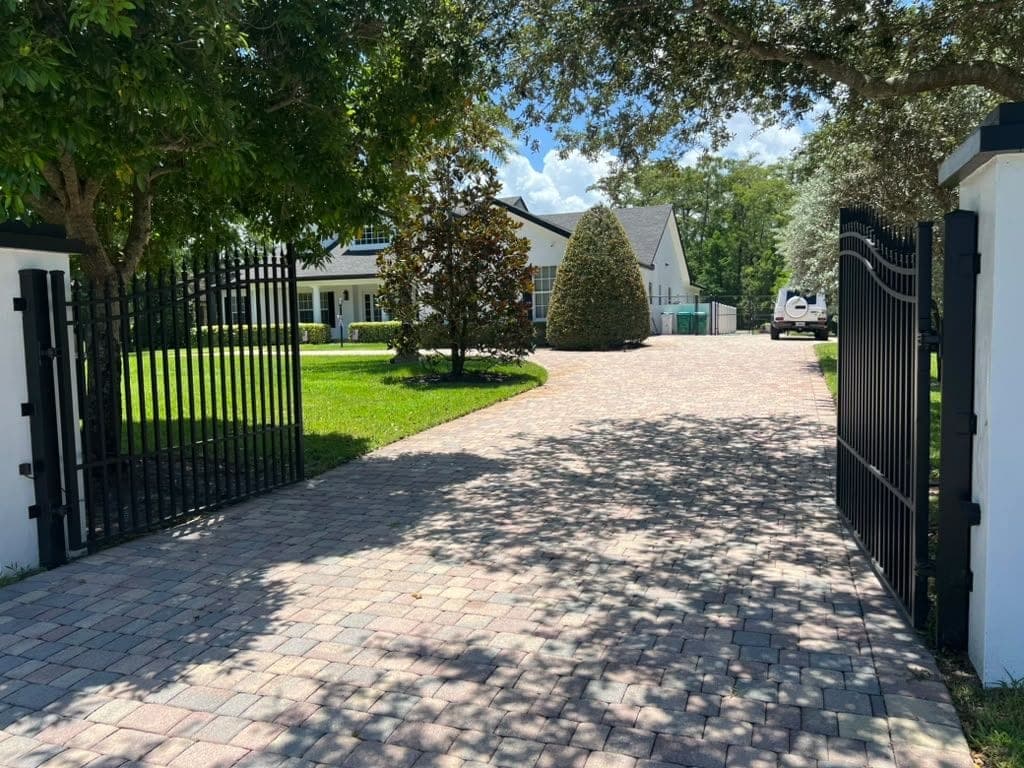
Open leaves take room out of the driveway, not just the opening
One leaf or two
On a swing gate the choice is mostly arithmetic. A pair of leaves halves the length of each, which halves the leverage on each hinge and each operator arm — a twelve-foot opening as two six-foot leaves is a far easier machine to keep in adjustment than the same opening as one twelve-foot leaf.
Single leaves get chosen for looks, or because there is only one usable hinge post. They are entirely doable, but the cost lands in places people do not expect: heavier frame sections to resist sag, a bigger hinge assembly, a deeper footing on the hinge side, and an operator rated for the leverage rather than just the weight. A long single leaf also sweeps a wider arc, which comes back to setback.
Two leaves: shorter arc each, smaller operators, easier to keep square, more hardware in the middle.
One leaf: cleaner look, one operator, considerably more structure — and every problem the gate ever has will be a leverage problem.
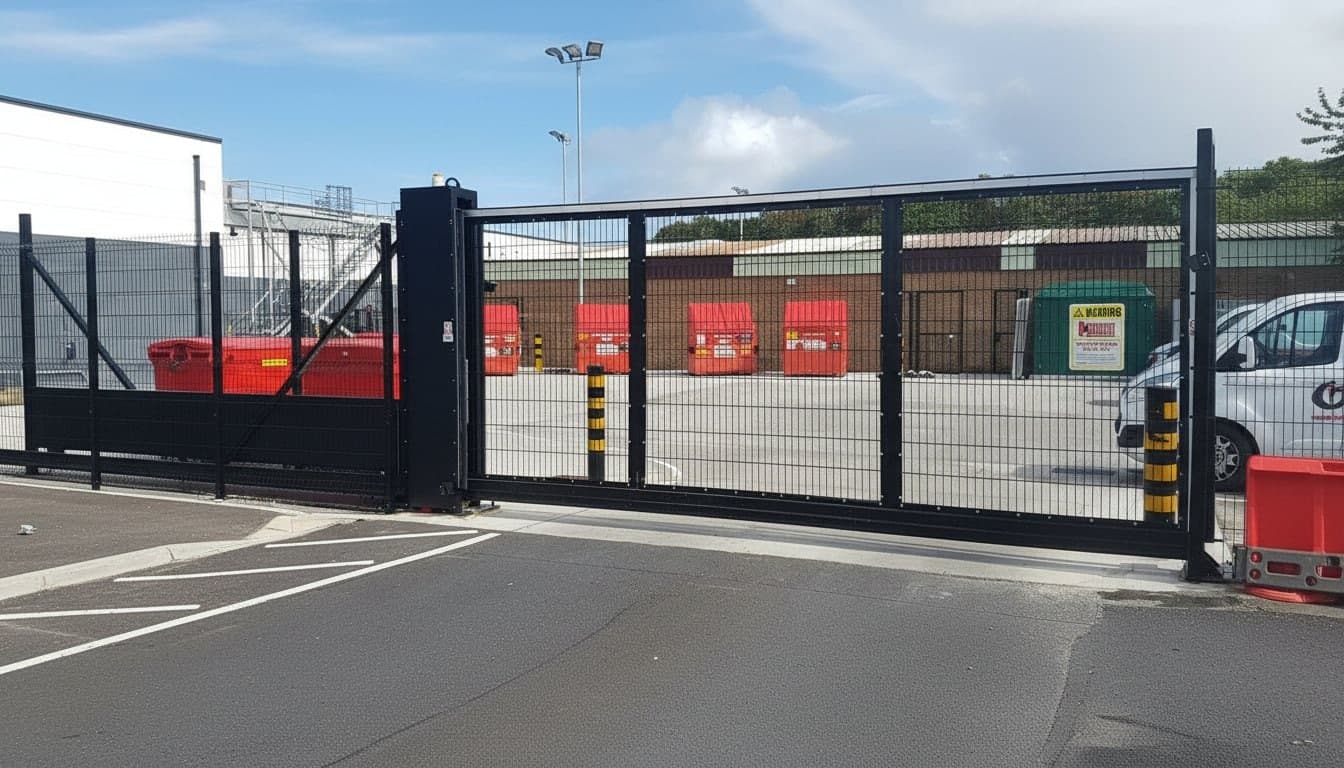
A slide gate is one leaf by definition, and its length question is about the run beside it rather than the arc in front of it.
Height, and the gap under the gate
Height is usually set by the fence it joins, and matching it is what makes a gate look like part of the property rather than a bolted-on afterthought. Where people go wrong is treating a taller gate as a free upgrade: height adds area, area adds wind load, and wind load lands on the posts and the footings. That is a structural conversation here, not a cosmetic one — see what the High-Velocity Hurricane Zone means for a gate.
Ground clearance is the other half of the same measurement. Almost every driveway apron in South Florida is crowned or pitched for drainage, so the gap under a gate is never constant across the opening. Too little clearance and the leaf catches on the high point; too much and it looks wrong, and it stops containing a dog. On a swing gate the clearance has to work through the whole arc, not just at the closed position.
What has to live beside the gate
The gate is the visible part. The layout around it is what makes it pleasant to use, and it needs planning at the same time.
01The entry device. A callbox or keypad has to be reachable from the driver's window without unbuckling — that means the right distance from the driveway edge and the right height for a truck and a low car both. Getting this wrong is the most common daily annoyance on an otherwise perfect installation, and the options are covered in choosing how people get through your gate.
02The operator and its cabinet. Swing operators need clearance behind the hinge line; slide operators need a pad, and a place for the board that is not standing in irrigation spray.
03Safety devices. Photo eyes need a clear line across the opening and loops need to go in before the driveway is finished, not cut into it afterwards — the standard has opinions about all of this.
04A pedestrian gate. Anyone arriving on foot will otherwise squeeze past the vehicle gate or climb it. A separate walk gate is cheap at build time and awkward to retrofit.
05Deliveries and mail. Decide where a courier stands, or you will find out by watching them decide.
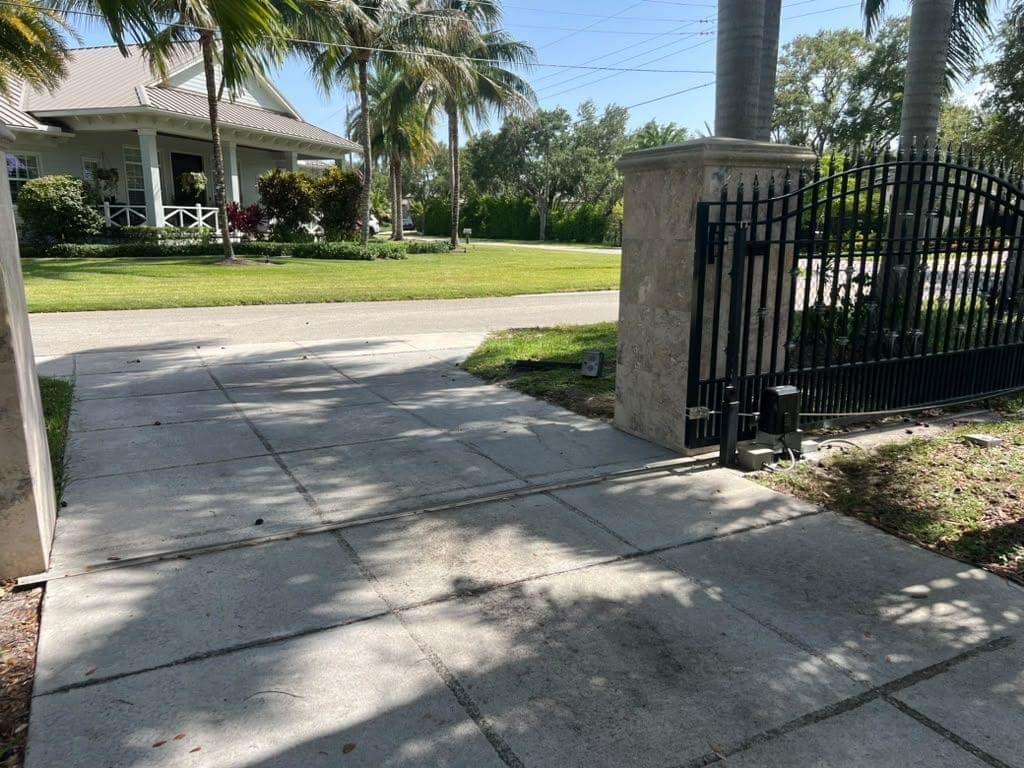
Pillar, operator and reader all compete for the same few feet
Measure these before anyone quotes you
01Clear opening width, pillar face to pillar face.
02Setback from the edge of the road surface to the gate line.
03Fall or rise across the opening, and across the swing arc if it swings.
04Fence height either side, and the height you want the gate to be.
05Clear run along the fence line in both directions, for a slide option.
06Distance from the gate to the nearest electrical panel.
07The widest and longest vehicle that regularly uses the driveway.
Seven numbers and a photograph from the street will tell an experienced installer nearly everything about what your entrance can and cannot support. We build to the opening — never to a stock size — across Pinecrest, Fort Lauderdale, Delray Beach and the rest of the coverage area. Send the measurements over and we will tell you what fits before anything is designed.
Published by Local Gate Repairs on . Written by the business rather than by a named author — this site does not publish a byline it cannot stand behind. General guidance for South Florida properties: every gate, driveway and operator is different, and permitting is administered locally, so treat this as a starting point rather than a specification for your own entrance. What this site does and does not claim is set out in full on standards & sources.