Most people call all of them 'the sensors'. They are three different devices doing three different jobs, and confusing them is how a gate ends up looking safe while leaving a real hazard uncovered.
July 31, 2026Updated August 1, 20266 min read1,306 words
An automatic gate is a heavy powered machine that operates unattended, often around children and pets, and usually with nobody watching it finish its cycle. That is the whole reason the safety devices exist — and they are worth understanding individually rather than as one vague category.
Three families, not interchangeable: devices that detect vehicles (loops), devices that detect anything in a beam (photo eyes), and devices that detect contact (edges). A fourth mechanism — the operator's own force sensing — sits behind all of them.
What UL 325 asks for, in plain terms
UL 325 (UL Standards & Engagement, opens in a new tab) is the safety standard, published by UL Standards & Engagement, that gate operators sold in the United States are built to. The part that matters to a homeowner is the concept of entrapment protection: for each place a gate can trap a person, the operator is required to have more than one independent means of protecting that zone. One of those means is typically the operator's own inherent force sensing. The other is an external device — a photo eye, or a contact edge.
Two consequences follow, and both get missed. First, "it has a photo eye" is not automatically a compliant installation — the zones needing cover include the far end of a slide gate's travel, not just the opening you drive through. Second, modern operators expect monitored devices: the board verifies the sensor is alive and refuses to run if it is not.
UL 325 governs the operator. The gate itself is the subject of a separate standard, ASTM F2200 (ASTM International, opens in a new tab), which is where the construction rules live: the gaps a hand can reach into, exposed rollers and pinch points, and how far a slide gate has to run past its opening. A compliant operator bolted to a gate that was never built to that spec still leaves a hazard, which is why the two are worth reading as a pair.
Loops: the gate's sense of vehicles
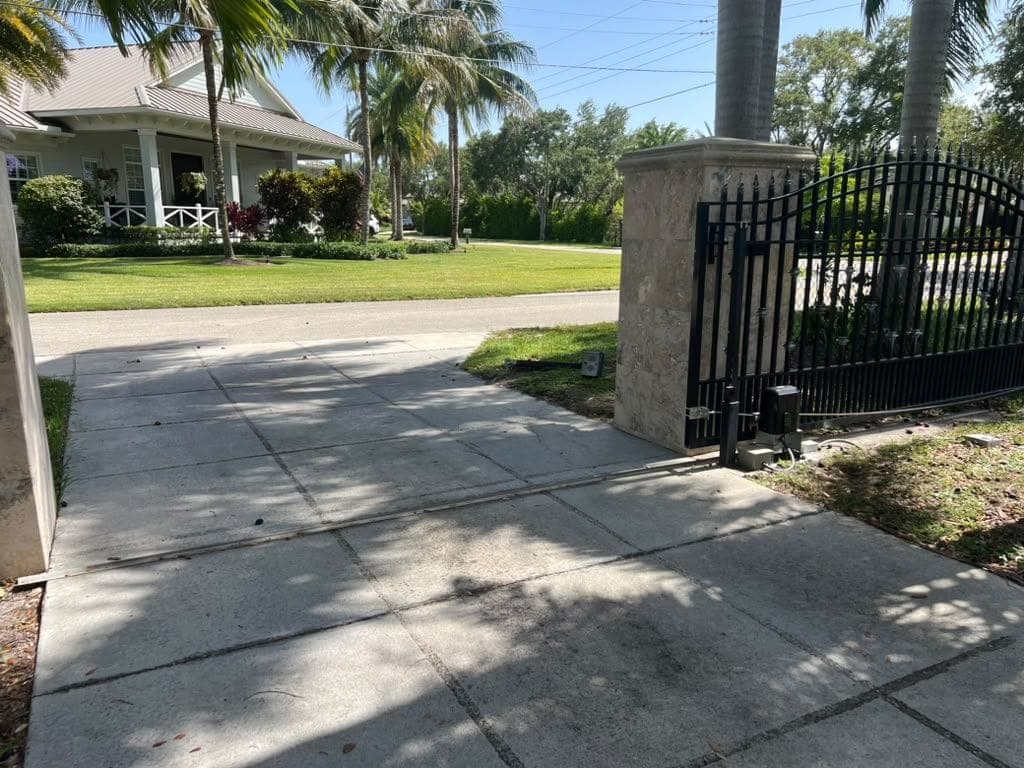
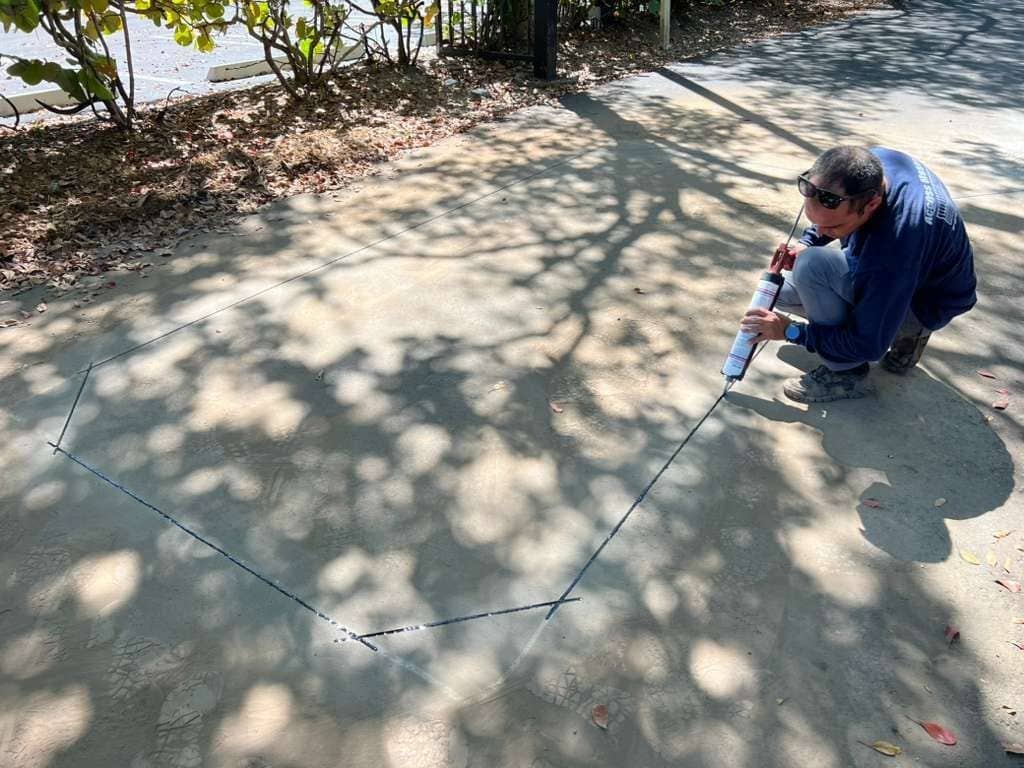
A loop is a coil of wire cut into a saw slot in the driveway, sealed, and wired to a detector watching its inductance. A large mass of metal passing over it — a car — changes that inductance. Loops do not see people, bicycles, dogs or strollers, and any explanation implying otherwise is wrong in a dangerous direction.
Exit loop (free-exit): sits inside the property and opens the gate automatically as you drive out, so you are not hunting for a remote on the way to work.
Safety loop (shadow loop): sits directly under the gate's path and holds the gate open while a vehicle is over it. This is the one that stops a gate closing on the middle of your car.
Centre or reversing loop: covers the swept area and reverses a closing gate if a vehicle is detected in it.
Interrupt loops on commercial sites do the same job under a barrier arm and are frequently paired with a second loop for direction logic.
Loops fail two ways. The wire breaks — usually where the driveway has cracked, or where the lead-in run was not twisted properly — and detection stops. Or the detector drifts and starts calling vehicles that are not there, which presents as a gate that will not close. Driveway resurfacing is the most common cause of a loop dying without warning.
Loop cut, laid and sealed
Photo eyes: the beam across the opening
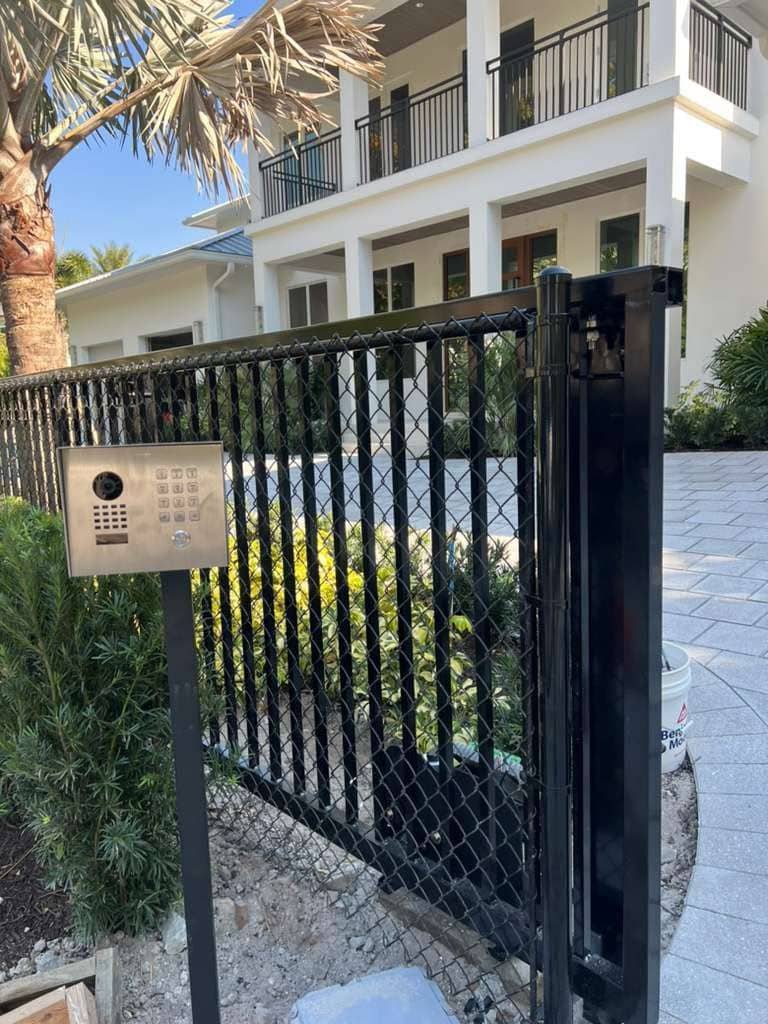
A photo eye projects an infrared beam across the gate's path. Break the beam and the gate stops or reverses. Unlike a loop, it does not care what broke it — a car, a child, a bicycle, a golden retriever all count. That is exactly why it is the device that protects people and the loop is the device that protects paintwork.
Through-beam
Separate transmitter and receiver, one either side of the opening.
Longer usable range and more tolerant of dirt and glare.
Needs power or wiring to both posts, which is the reason it is skipped.
Retro-reflective
One powered unit, a reflector on the far post.
Much simpler to install — only one side needs wiring.
More sensitive to a dirty or misaligned reflector, and to low sun straight down the driveway.
Height matters more than brand. A beam set at bumper height protects vehicles and passes straight over a toddler, so common practice is to cover the height range where a small child actually is — often more than one beam.
In this climate, lenses are a maintenance item. Salt haze, pollen, lovebug season and spider webs all scatter infrared, and a fogged lens produces a gate that becomes unreliable gradually rather than failing outright — which is precisely the pattern behind most gate stops halfway calls.
Contact edges: the last line
An edge sensor is a compressible rubber strip along the leading rail of the gate — and, on the installations that get it right, along the trailing rail and the gate post face too. Squeeze it and a switch inside closes, telling the operator it has touched something. It is the only device on the gate that reports actual contact.
Edges cover the zones photo eyes cannot: the pinch point where a swing gate closes against its post, and the far end of a slide gate's travel behind the fence line — the zone that puts a limb between a moving leaf and a fixed post. On slide gates and on any solid-infill gate, an edge is not an upgrade; it is what the geometry requires.
Testing yours, twice a year
01Wave an object through the photo eye beam while the gate is closing. It should stop or reverse immediately, every time, at both edges of the opening.
02Clean both lenses and the reflector, then repeat the test.
03Press the contact edge by hand mid-travel — a length of timber is safer than a limb. The gate should reverse.
04Drive onto the safety loop and stop. The gate should hold open and stay open.
05Watch a full cycle from the side. Look for hesitation, for a leaf that touches its stop hard, for a slide gate whose far end is uncovered.
06Never test any of it with a person or a pet.
If any of those tests does not do what it should, the gate is running on fewer layers than it was designed with, and that is worth fixing before it is worth ignoring. We retrofit loops, monitored photo eyes and edges across Miami, Pembroke Pines, West Palm Beach and the rest of the three counties — tell us what your gate currently has and we will tell you what it is missing.
Sources
The bodies that publish the standards and rules named above. Every link goes to the organisation itself, so anything asserted here can be checked at the source rather than taken on our word.
Published by Local Gate Repairs on , last revised . Written by the business rather than by a named author — this site does not publish a byline it cannot stand behind. General guidance for South Florida properties: every gate, driveway and operator is different, and permitting is administered locally, so treat this as a starting point rather than a specification for your own entrance. What this site does and does not claim is set out in full on standards & sources.