A hum means the motoris trying. Something is stopping it.
A humming operator is not a dead operator. Power is reaching the motor and something is preventing it from turning the gate — and the something is usually one of five things you can narrow down in ten minutes.
July 31, 20266 min read1,308 words
A hum is a good sign, oddly. It means the command reached the board, the board closed the circuit, and current is sitting in the motor windings. Nothing upstream is broken. The fault is at the motor, at the thing it drives, or at the gate it is trying to move — a much smaller haystack than "my gate died".
It is also a sound you should not let run. A motor energised and not turning has no cooling and nothing to do with the energy, so all of it becomes heat in the windings. Take two short attempts, then stop. Holding the button on a stalled motor is how a repairable fault becomes a replacement.
First: is the drive actually engaged?
Every operator sold in the US has a manual release, because the UL 325 standard requires a way to move the gate by hand with no power. That release is a clutch, a lever or a keyed cam depending on the machine, and once it is disengaged the motor hums entirely independently of the gate.
This is the single most common cause of a humming gate that goes nowhere, and it is free to fix. Somebody released the gate during a power cut, pushed it open by hand and never re-engaged it — a landscaper, a delivery driver, or the last storm.
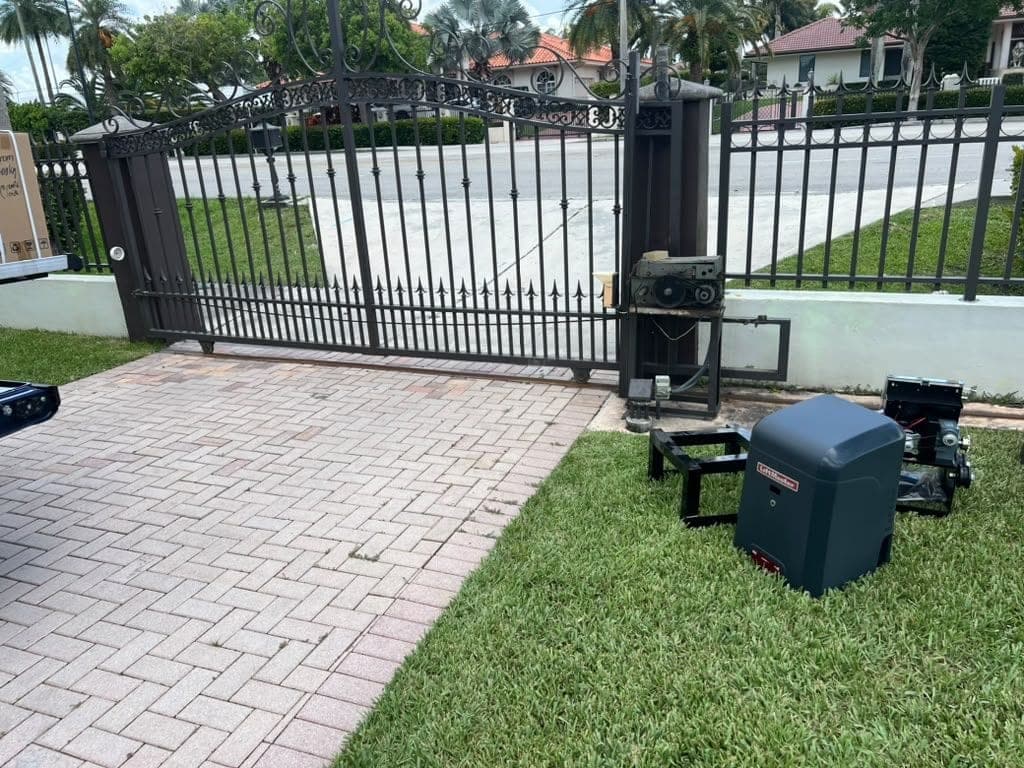
Find your release. On a swing arm or ram it is usually a small keyed cover on the body. On a chain-drive slider, a lever or knob on the gearbox. On rack-and-pinion, sometimes a hinged plate that lifts the pinion clear of the rack.
Push the gate by hand. If it moves freely with the motor idle, the drive is disengaged — re-engage it and cycle the gate.
If it will not re-engage smoothly, do not force it. The gate is usually parked slightly off where the clutch expects; move it an inch either way and try again.
AC operators: the start capacitor
If the machine runs on line voltage rather than a battery, a hum with no rotation is the textbook symptom of a failed start capacitor. A single-phase motor cannot start itself — one winding gives you a field that pulses back and forth rather than rotates, and the rotor sits in it and buzzes. The capacitor shifts current in a second winding out of phase, and that phase difference is what makes the field turn.
When the capacitor dies, the motor has full voltage, full current and no starting torque. It hums, it heats, and a thermal cutout eventually opens. The giveaway: if the gate runs normally after somebody nudges it by hand in the right direction, that is a start-circuit failure and almost nothing else.
DC operators: the battery collapsing under load
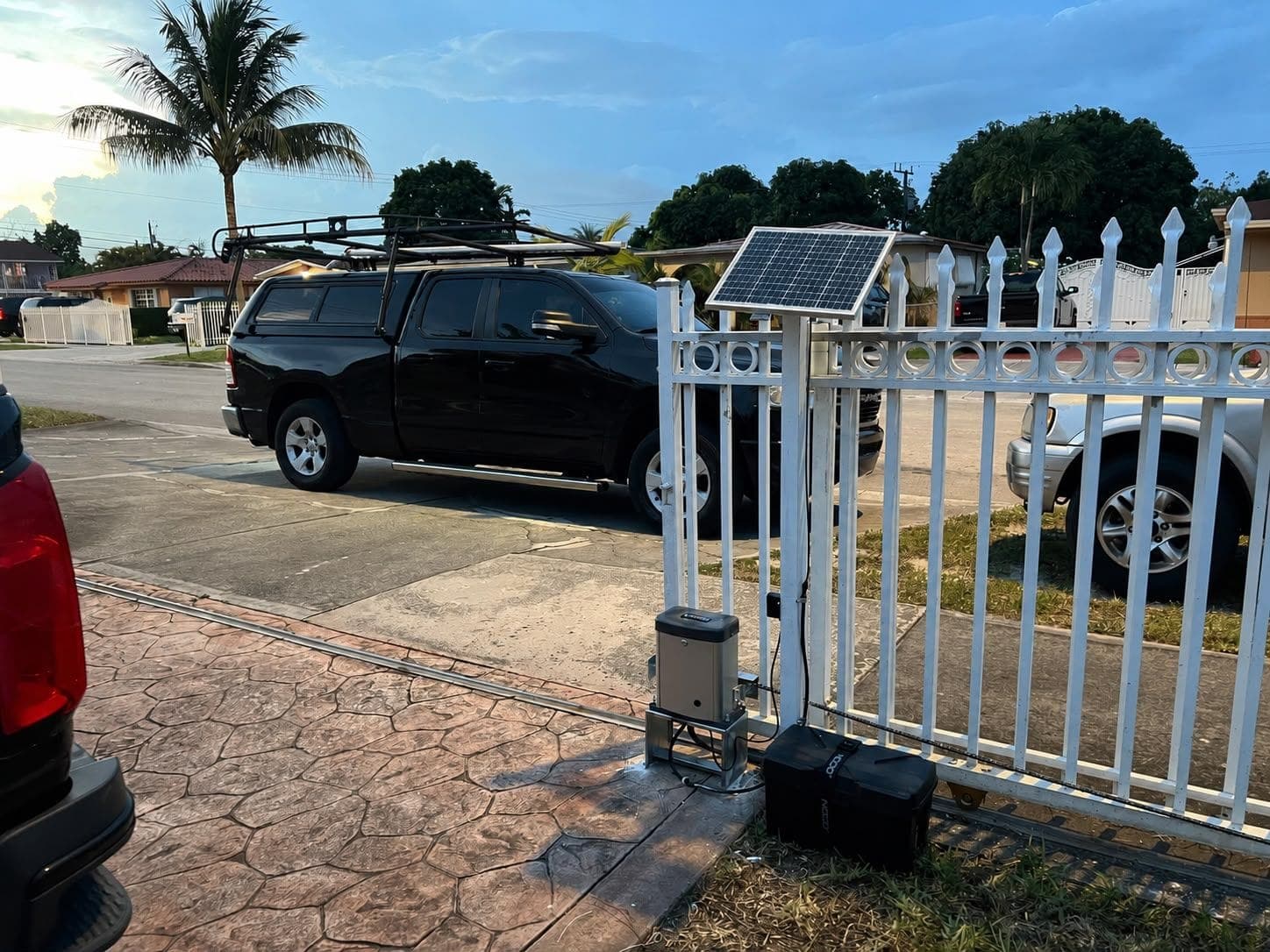
Most residential operators here are DC machines running off a sealed battery, with a transformer or solar panel keeping it topped up. On those, a hum or a grunt with no movement is very rarely the motor — it is the battery failing to deliver current.
A tired sealed battery reads a respectable voltage at rest and sags to nothing the instant a motor asks for starting current. What you hear is the board energising, the voltage crashing, the board dropping out and the whole thing repeating — a hum, a click, or a rapid chatter from inside the cabinet. Heat kills these batteries here, not cycles, so one that has seen two Florida summers is a suspect no matter how little the gate gets used.
The tell is context. Humming in the morning and working by noon is a solar site on a battery that no longer holds much. Starting after a multi-day outage means it was deeply discharged and may not have come back. Either way the test is a load test, not a voltmeter across the terminals.
Solar-charged sites live and die by the battery
The motor is turning and the gate is not
Put a hand flat on the operator housing while it hums. A stalled motor feels dead and buzzy; a spinning one feels smooth and busy. If it is spinning, the fault sits between the motor and the gate, and that is a short list.
A sheared key or roll pin on the output shaft — the gearbox turns, the sprocket does not. Usually follows a jam that got driven against.
A stripped gear inside the gearbox, often a nylon one designed as the sacrificial part.
A chain that has jumped the sprocket, stretched or parted at a link. Look along the whole run, not just at the operator.
A pinion that has climbed out of the rack, or a rack section whose bolts have worked loose so the teeth no longer mesh.
A slipping clutch. Some operators use a friction clutch as a torque limiter, and a glazed lining slips at loads it should hold.
Or the gate itself is genuinely stuck
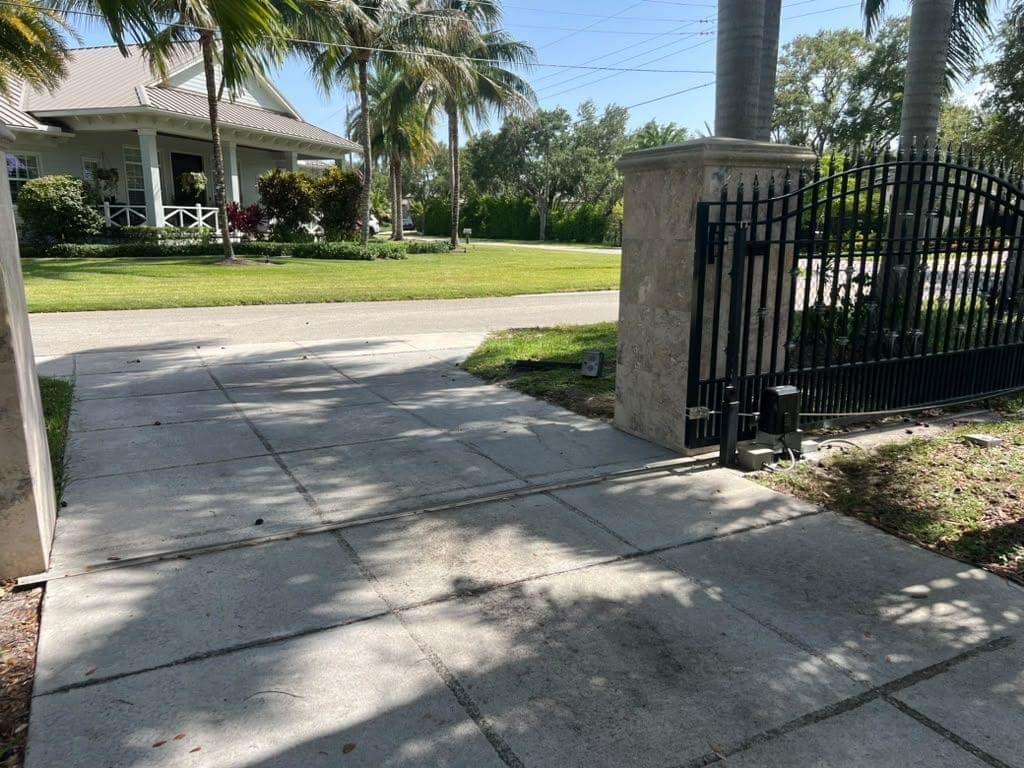
The last possibility is the least exotic: motor fine, drive fine, gate physically cannot move. A wheel bearing seized after a wet season. A V-track packed with sand and crushed shell. A swing hinge rusted into one piece. A post shifted enough to bind the leaf against its stop.
Release the drive and try to move the gate by hand. A healthy gate takes steady, even effort through its whole travel. If it will not budge, or binds hard at one point, the operator was never the problem — worth knowing before anyone quotes you a new machine. Coastal hardware seizes for reasons that are entirely predictable, and a gate that has become heavy to move is also the reason a lot of operators die early.
Where the line sits
Reasonable to do yourself
Check the manual release is engaged, and re-engage it if not.
Release the drive and move the gate by hand to feel for binding.
Look along the chain, rack or arm for something obviously adrift.
Clear the track, the arc and the hinge line.
Note what you heard — hum, click, chatter, or hum then silence.
Call someone
Anything involving a capacitor, ever.
Anything inside the control cabinet, live or not.
Battery testing on a machine you did not fit.
Sheared keys, stripped gears, slipping clutches or gearbox work.
A seized roller, hinge or post — a mechanical rebuild, not an operator fault.
The detail that shortens a visit most is the sequence. Does it hum immediately or after a delay? In both directions or only one? Does it go quiet on its own, or keep going until you let go? Each points at a different half of the list above. We work on operators across Coral Gables, Boca Raton, Weston and the rest of the three counties — tell us what it sounds like and we will tell you what we would check first.
Published by Local Gate Repairs on . Written by the business rather than by a named author — this site does not publish a byline it cannot stand behind. General guidance for South Florida properties: every gate, driveway and operator is different, and permitting is administered locally, so treat this as a starting point rather than a specification for your own entrance. What this site does and does not claim is set out in full on standards & sources.