A gate that opens perfectly and then refuses to close is rarely a motor fault. Almost everything designed to protect a person guards the closing stroke, so the close direction is where those devices show up first.
July 31, 20266 min read1,300 words
This is the most diagnostically useful symptom a gate produces, because the two directions are not treated equally. Opening moves the gate away from the space a person occupies; closing moves it toward them. Every entrapment protection device on the system exists to govern the closing stroke — so when opening works and closing does not, the motor, the drive and the power supply have all just proved themselves.
Before you look at anything, answer one question. Does the gate begin to close and then stop or reverse, or does it never start at all? Those are two different families of fault, and the rest of the diagnosis follows from it.
It starts closing, then stops or reverses
A photo eye is broken partway through the stroke.
An edge sensor is making contact, or is damaged and reading as pressed.
The gate has developed drag and is tripping the force threshold.
Wind is loading the leaf against a close-direction force limit set fine.
It never begins to close at all
A safety device is blocked before the cycle can even start.
An exit loop or free-exit device is detecting a vehicle that is not there.
A hold-open input is latched — a switch, a relay, a stuck button.
Timer-to-close is off, or was never on, and nothing is sending a close command.
Photo eyes: the usual answer
On most residential installs the photo eyes are wired to the close direction only. The beam crosses the gap the gate is about to close into, so blocking it must stop the close while opening is unaffected. That is exactly why the failure presents as "opens fine, will not close".
Anything that interrupts or weakens that beam reads as a person standing in the gap. Spider silk across a lens does it. Salt haze does it. A hedge that has grown three inches since March does it. So does a post quietly pushed out of true by a sprinkler washing its base for a year — the beam is aimed to a tolerance measured in millimetres across a driveway.
Wipe both lenses properly — a dry cloth on a salt-filmed lens just smears it.
Check the status LEDs against the manufacturer's legend. The colours are not standardised, so green does not automatically mean aligned.
Cut back anything growing near the beam path, including grass at the base of a low-mounted eye.
Check both posts are still plumb and neither has been knocked by a vehicle or a mower.
If none of that clears it, the sensor pair itself may be failing, and the differences between the sensor types matter — a through-beam pair that has lost a power leg behaves nothing like a retro-reflective unit whose reflector has clouded.
Exit loops that never stop detecting
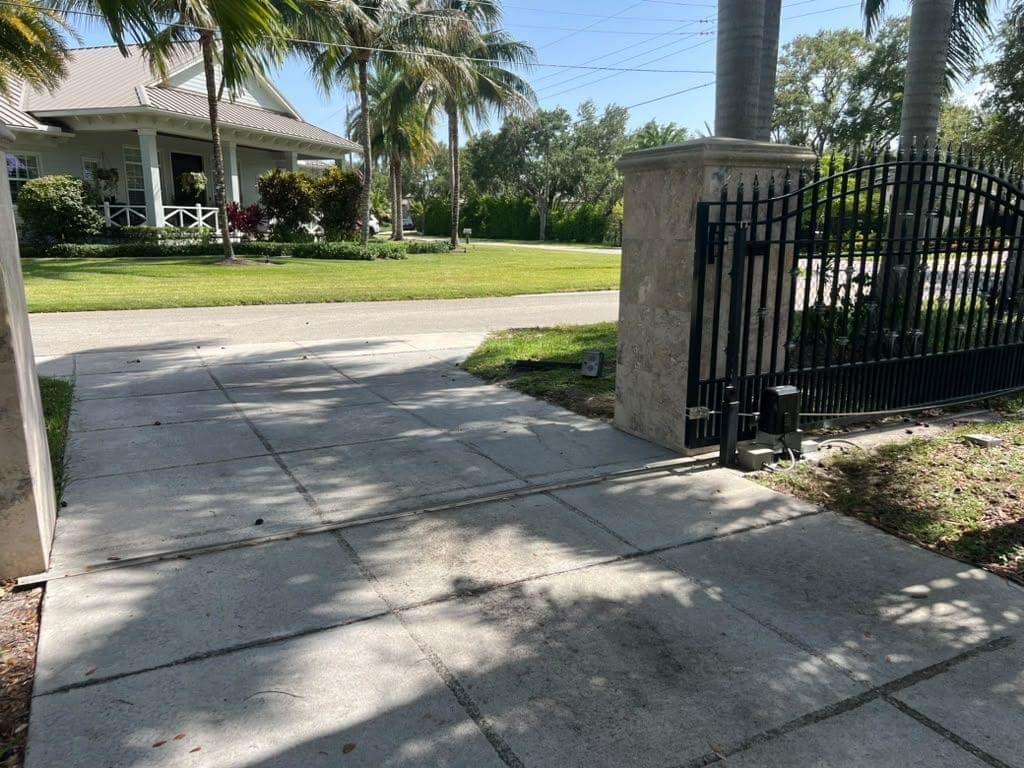
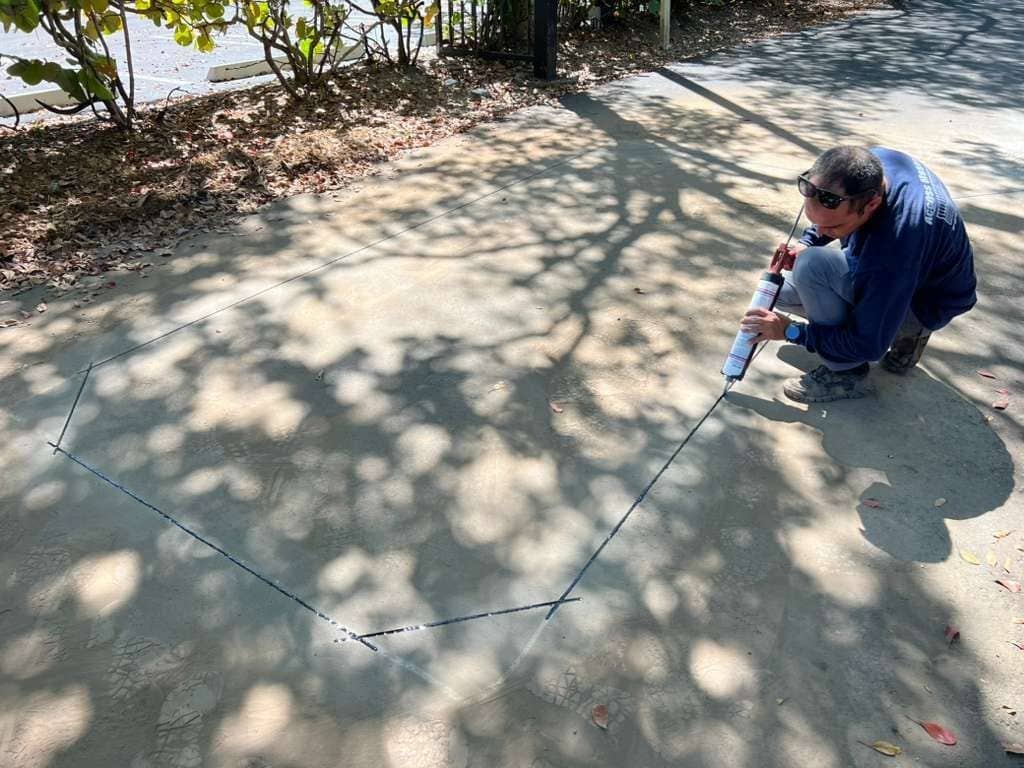
If the gate opens on its own when a car approaches from inside, there is a wire loop cut into the driveway — a coil in a sawcut, filled with sealant, driven by a detector watching the coil's inductance. A lump of steel parked over it changes that inductance and the detector reports a vehicle.
Two loop faults produce a gate that sits open indefinitely. The first is a genuine permanent detection — something metallic left over the loop, or a shorted or broken loop wire that has pinned the detector on. The second is water: a sawcut whose sealant has cracked lets water into the slot, and loop wire insulation is not built to sit submerged forever.
Walk the driveway and find the sawcut lines. Check nothing metal is sitting on them — a trailer jack, a bike rack, a steel plate left by a contractor.
Look at the sealant. Cracked, sunken or missing sealant over a loop is a common cause here after a wet season.
Most detectors have a fault LED and a detect LED. If the detect light is on with an empty driveway, that is your answer.
A loop that failed after the driveway was resurfaced or a trench was cut has been damaged. That is a re-cut, not an adjustment.
A loop sawcut, sealed — the sealant is the part that fails
Something is holding it open on purpose
Every operator has one or more inputs that mean "stay open", and any of them stuck closed gives you a gate that opens obediently and then waits. A wall button whose plunger no longer springs back. A callbox relay welded shut after a surge. An intercom door-release output stuck on. On a community entrance, an emergency-access input that was triggered and never reset.
The related possibility is more boring and more common than people expect: there is no close command at all. Many operators only close because a timer-to-close setting tells them to, seconds after they finish opening. Disable that — during a service visit, or when a replacement board came up on factory defaults — and the gate opens every time and never closes itself, while the remote closes it perfectly. If the remote closes it on demand, stop looking for a fault. The timer is off.
Edge sensors, force and the wind
If the gate starts closing and reverses, and the photo eyes are clean and aligned, the next two suspects are the edge sensor and the force setting. A safety edge is a rubber extrusion with a contact strip inside: the gate touches something, the rubber compresses, the contact closes. Once that rubber is cracked, waterlogged or crushed from an old impact it can read as permanently pressed, which the board takes as the gate hitting somebody on every close attempt.
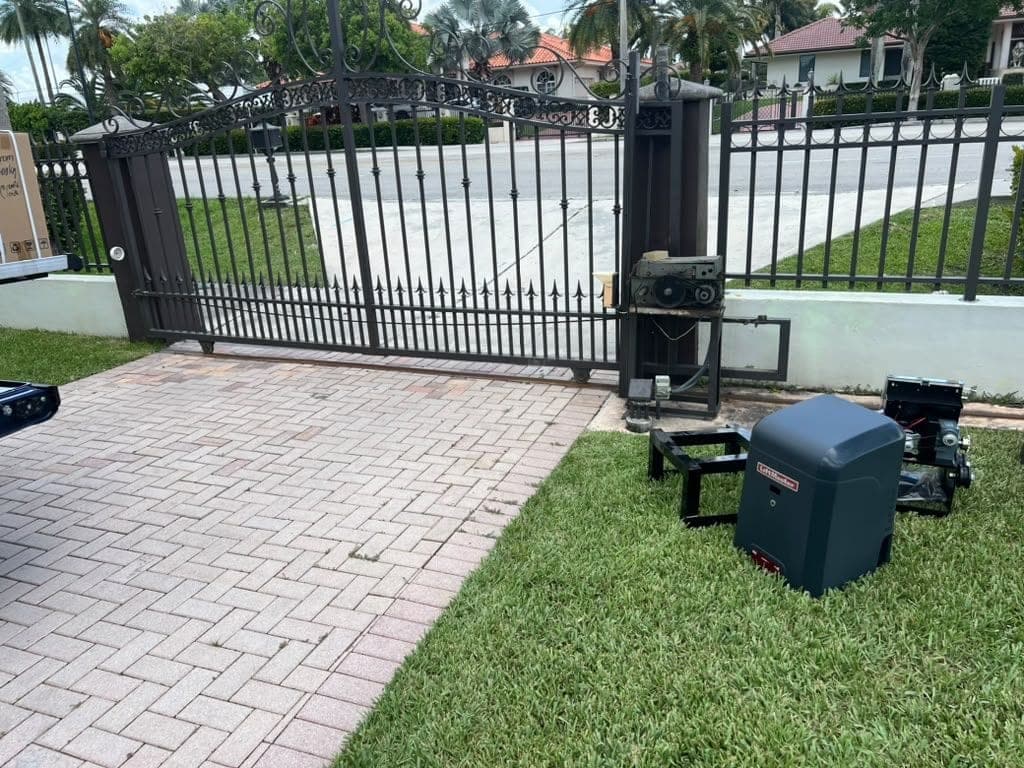
Force sensing is the other. The operator watches how hard it is working and reverses if the load jumps. Any drag in the closing direction — a flat-spotting roller, a dropping hinge, a sagged leaf whose leading edge now scuffs, grit in the track — will trip it. Wind counts too: a solid-clad leaf closing into a sea breeze is a sail, and close is where that load shows up first.
What to have ready
Four observations get most of the way there before anyone opens a cabinet: whether it starts closing, whether the remote can close it manually, whether it fails at a particular time of day, and what changed recently — a storm, a resurfaced driveway, new landscaping, a board swap, a power cut.
Published by Local Gate Repairs on . Written by the business rather than by a named author — this site does not publish a byline it cannot stand behind. General guidance for South Florida properties: every gate, driveway and operator is different, and permitting is administered locally, so treat this as a starting point rather than a specification for your own entrance. What this site does and does not claim is set out in full on standards & sources.