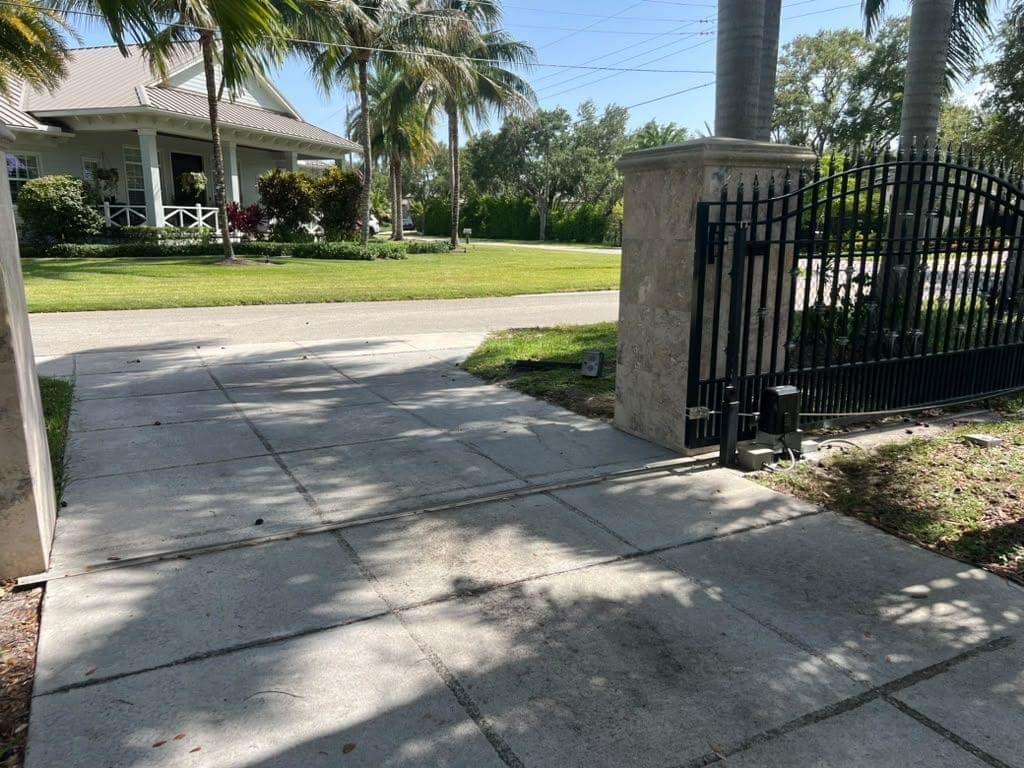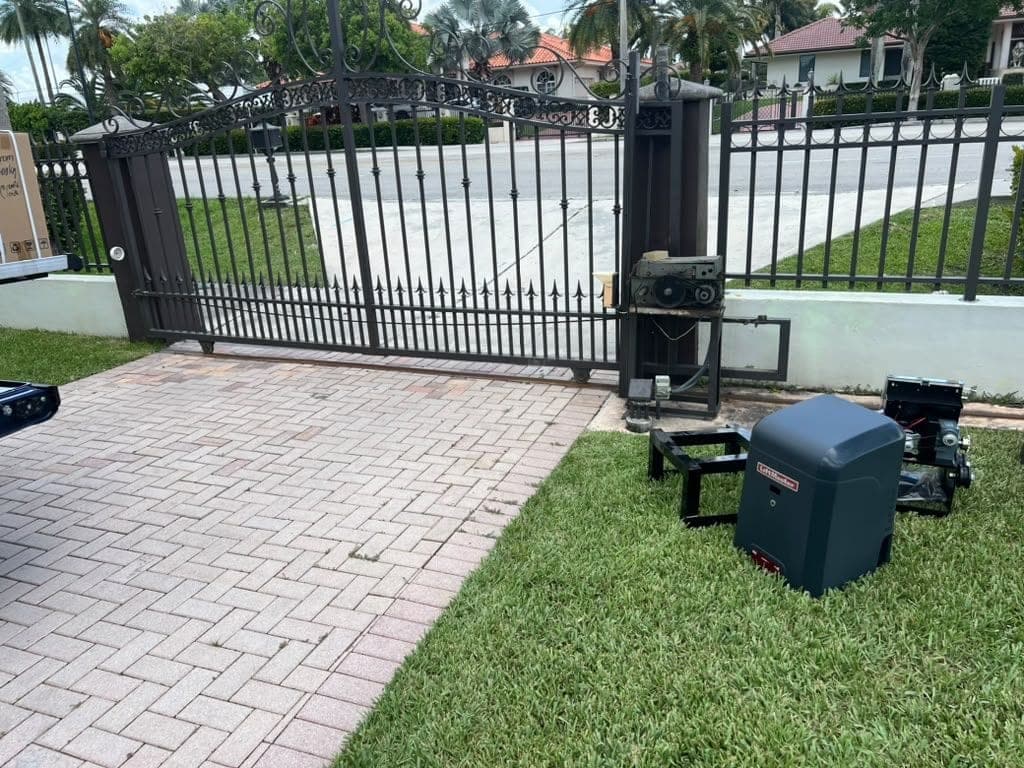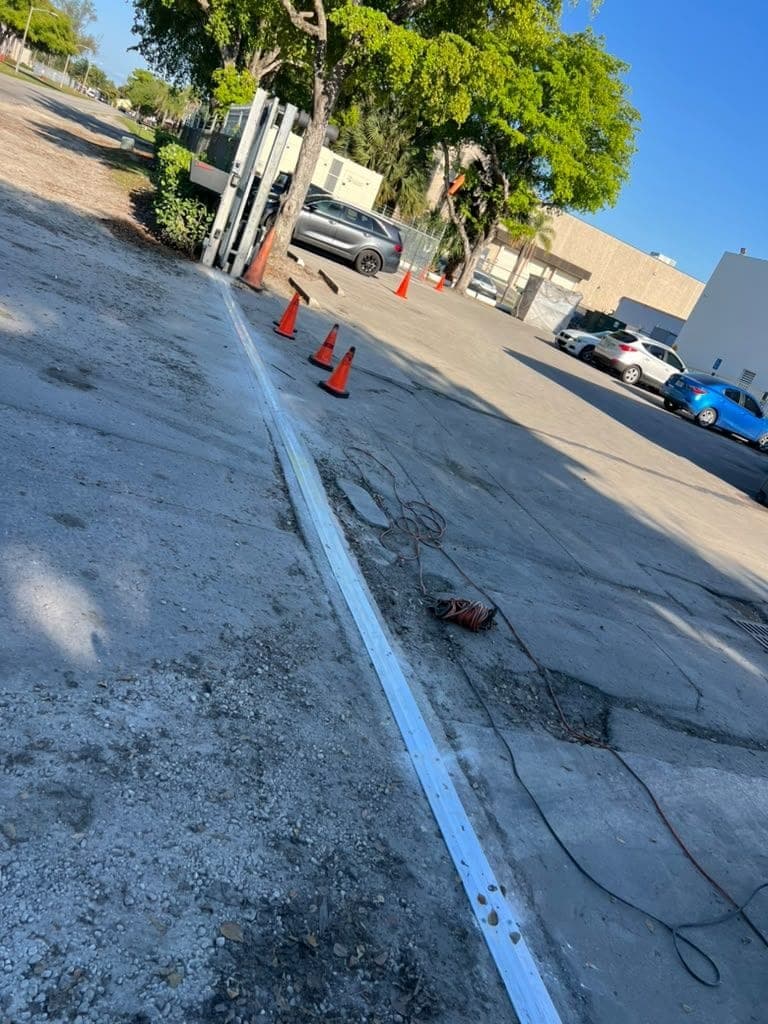

Sliding gate track being replaced at a driveway entrance with tools laid out on the ground

Diagnosis · Mechanical

A grinding gate is metal removing metal somewhere, and it is getting worse every cycle. Two simple tests tell you whether the noise belongs to the gearbox, the drive, the track or the gate itself.

July 31, 20266 min read1,300 words

Grinding is not a mood a gate is in. It is a specific description: two surfaces in contact that were never meant to be, or two that were meant to be but have lost the film between them. Either way material is coming off every cycle, so the fault compounds — which makes a grind one of the few gate noises worth acting on rather than getting used to.

The good news is that finding it costs nothing. You are answering two questions, and the answers usually name the part.

The two tests that locate it

Does the noise track position, or speed?

Stand back and run a full cycle. If the grind happens at the same point every time — three feet out, or the last two feet of closing — it is positional, which means the gate is meeting something at a place: track, rollers, ground, a rack section. If it is continuous and rises and falls with the motor rather than with position, it belongs to the drive.

Does it grind with the power off?

Release the manual disconnect and push the gate by hand through its whole travel. If you can reproduce the noise by hand, the operator is innocent and the fault is in the gate, track, rollers or hinges. If it moves quietly by hand and only grinds under power, the noise lives in the operator or the drive. Pay attention to how it feels, too — a healthy gate takes steady, even effort throughout.

Continuous under power: the gearbox

A grinding gearbox sounds like what it is — hard, metallic, unrelenting, pitched with the motor rather than the gate. Most residential operators use a worm and wheel running in grease, and grease is a soap holding oil. Heat drives the oil out, and an aluminium housing in full Florida sun gets plenty of heat. What is left is not a lubricant, and the teeth start wearing each other.

Bearings fail faster. A dry or pitted output bearing gives a rougher, rumbling grind, sometimes with a wobble you can feel through the housing. Both are the failures most likely to turn into a replacement rather than a repair — this is the one where continuing to run the gate genuinely costs money. If the operator has also been getting slower and fussier, treat that as one conversation rather than two.

Close view of a gate operator motor and gearbox housing mounted at a gate post
Where a continuous, speed-linked grind comes from

Chain drives and rack-and-pinion

On a slide gate the operator reaches the gate through a chain or a toothed rack, and both make noise in characteristic ways.

  • A stretched chain no longer matches the sprocket's pitch, so it climbs the teeth instead of seating in them. You get a rhythmic crunch that speeds up with the gate, and teeth gone hooked rather than symmetrical.
  • A chain that is too tight grinds at the bearings and heats the gearbox. Too slack and it slaps, jumps a tooth and grinds as it re-seats. There is a correct sag, and it is not "as tight as possible".
  • On rack-and-pinion, the rack must carry no weight — the pinion drives it, it does not hold the gate up. Loose bolts or sections sagging between fixings drop the gate's weight onto the pinion teeth, and that destroys a pinion fast.
  • Rack sections shifted at the joints grind at exactly one point in travel, every cycle — positional noise that is not a track problem.

Positional grinding on a slide gate

A V-groove wheel on a V-track is a simple arrangement with one weakness: the groove is a trap. Sand, crushed shell and the fine grit that comes off a paver driveway collect in the V, and the wheel rolls that grit into both surfaces. Give it two years and you get a track worn to a ridge and wheels with a flat facet where the groove used to be round.

  • Sweep and hose the whole track, including the length that sits under the gate when it is closed. Most people only clean the exposed half.
  • Look for a wheel that is not turning. A seized bearing drags a stationary wheel along the rail, which grinds loudly and ruins the track.
  • Rotate each wheel by hand with the gate disconnected and watch for a flat spot or a stutter.
  • Look at the ground rather than the gate. A fresh silver scuff marks exactly where it is touching.
  • On a cantilever gate the wheels sit inside truck assemblies at the posts. The same wear happens out of sight, showing up as a grind that worsens as the gate extends.

Swing gates: hinges and geometry

Swing gates grind for different reasons because they have no track. The hinge is the whole bearing. A dry pin in a rusted barrel squeals and then grinds, and a hinge whose bronze or nylon bushing has worn through starts running steel on steel — at which point the leaf drops a few millimetres, the geometry changes, and the leading edge begins scuffing the ground or fouling the receiver post.

So a swing gate grind is often two faults stacked: something wore, the gate sagged, and the sag now produces a second noise somewhere else. Fixing the scuff without fixing the hinge only resets the clock. Corrosion inside a hinge barrel is the most predictable failure on a coastal property, for reasons worth understanding. Post movement counts too — a hinge post that has leaned a degree makes the leaf rise or fall through its arc.

What to do and what to leave

Reasonable to do yourself

  • Sweep and hose the full track, closed section included.
  • Disconnect the drive and move the gate by hand to reproduce the noise.
  • Look for scuffs on the ground and fresh dust under the drive.
  • Note whether the noise is positional or continuous.
  • Stop using the gate if the noise is new, loud and metallic.

Call someone

  • Gearbox and bearing noise, always. This is the one with a deadline.
  • Rack alignment — the tolerances are small and getting it wrong destroys the pinion.
  • Chain tensioning, sprocket replacement or anything requiring the drive to come apart.
  • Roller, track or hinge replacement, and any gate that has sagged.
  • A post that has moved. That is a foundation job, not a hardware one.

Catching a grind early is mostly a matter of money: a roller and a length of track is a different job from a rebuilt drive and a bent leaf. Describe where in the travel it happens and whether you can reproduce it by hand. We work on tracks, rollers, chains and hinges across Fort Lauderdale, Miami Beach, Jupiter and the rest of the three counties. Tell us where it grinds.

Published by Local Gate Repairs on . Written by the business rather than by a named author — this site does not publish a byline it cannot stand behind. General guidance for South Florida properties: every gate, driveway and operator is different, and permitting is administered locally, so treat this as a starting point rather than a specification for your own entrance. What this site does and does not claim is set out in full on standards & sources.

Next step

It starts witha drawing.

On-site consults across South Florida. You see the gate on your own entrance before you commit to anything.

Call NowGet a Quote