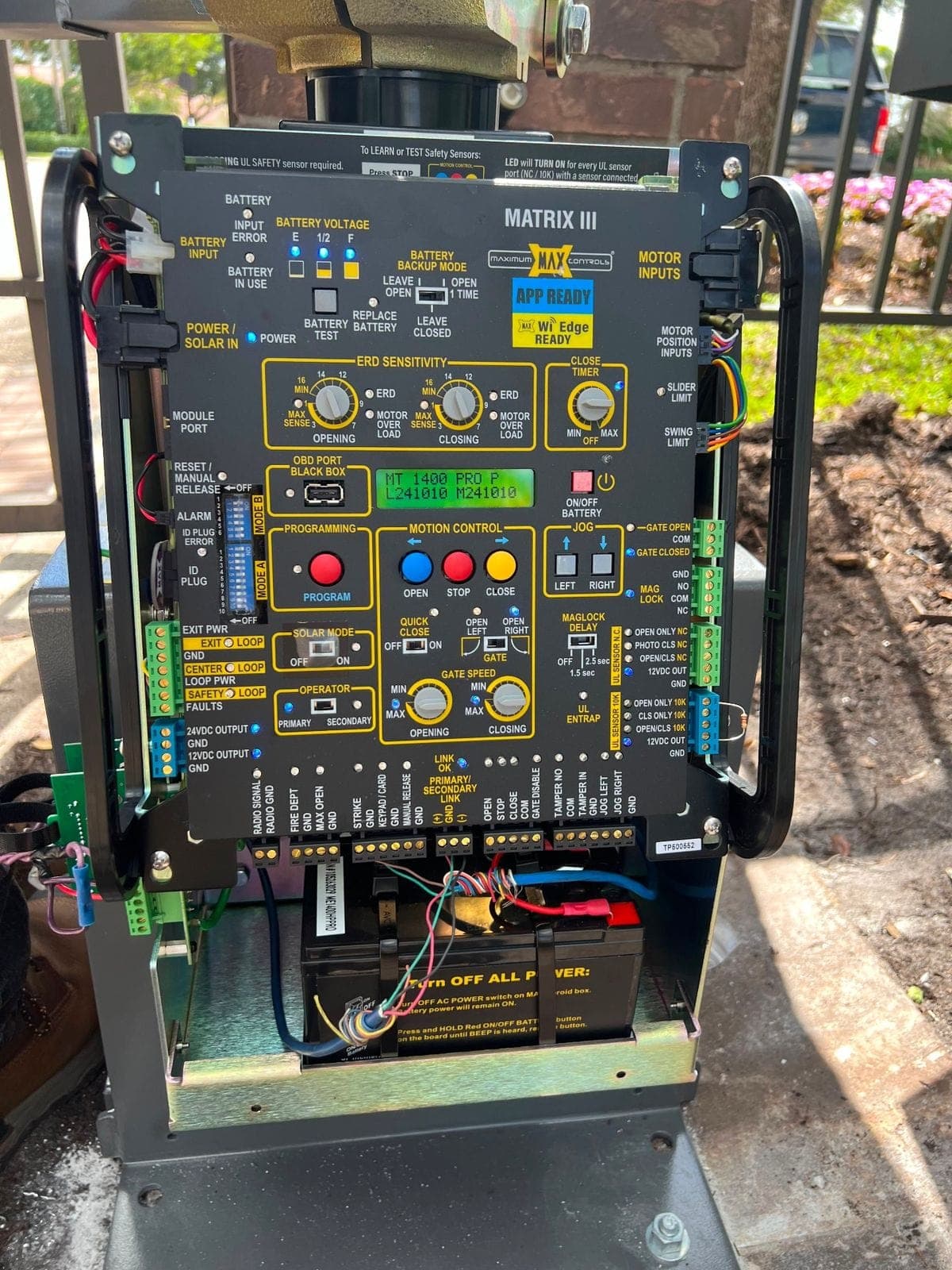
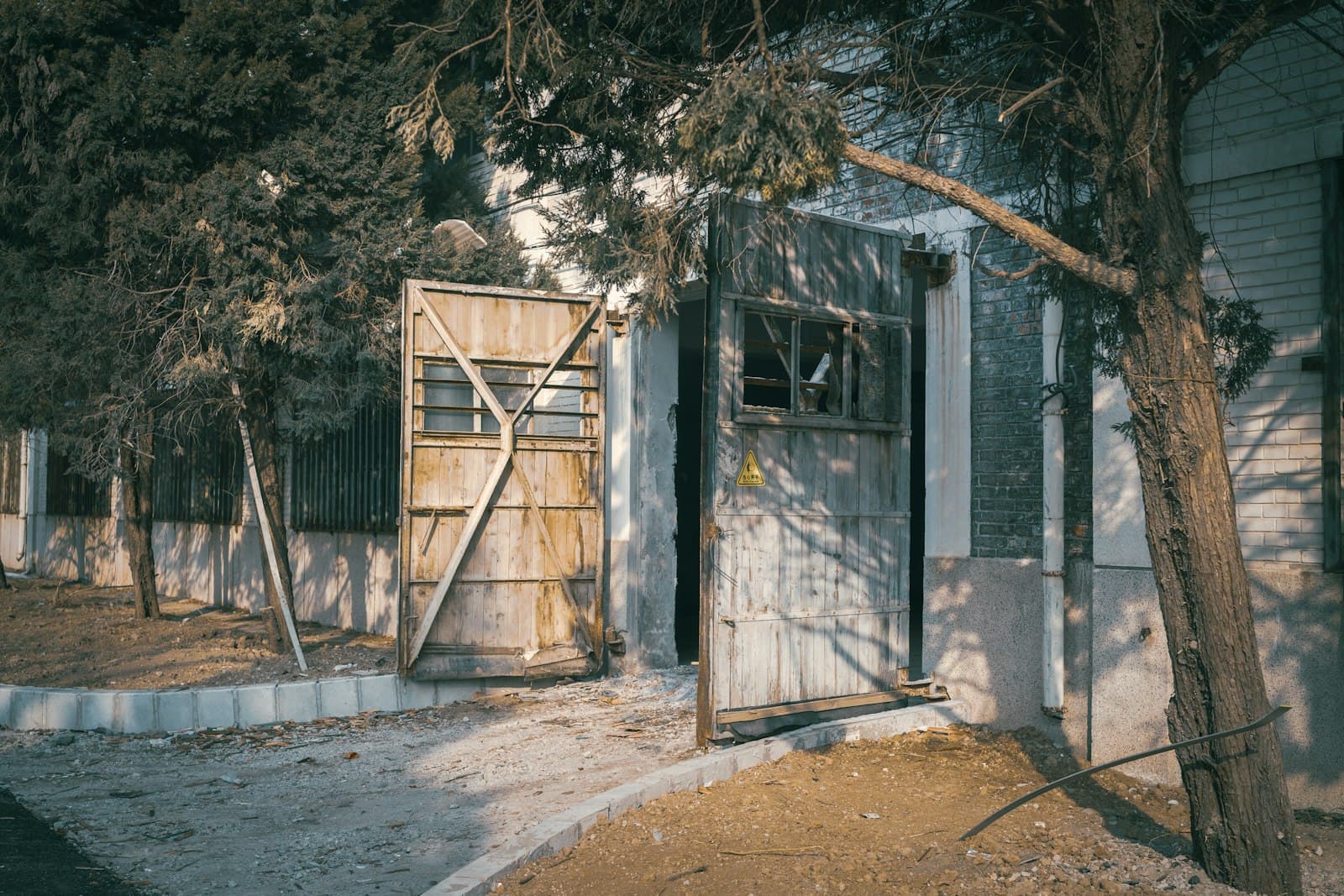
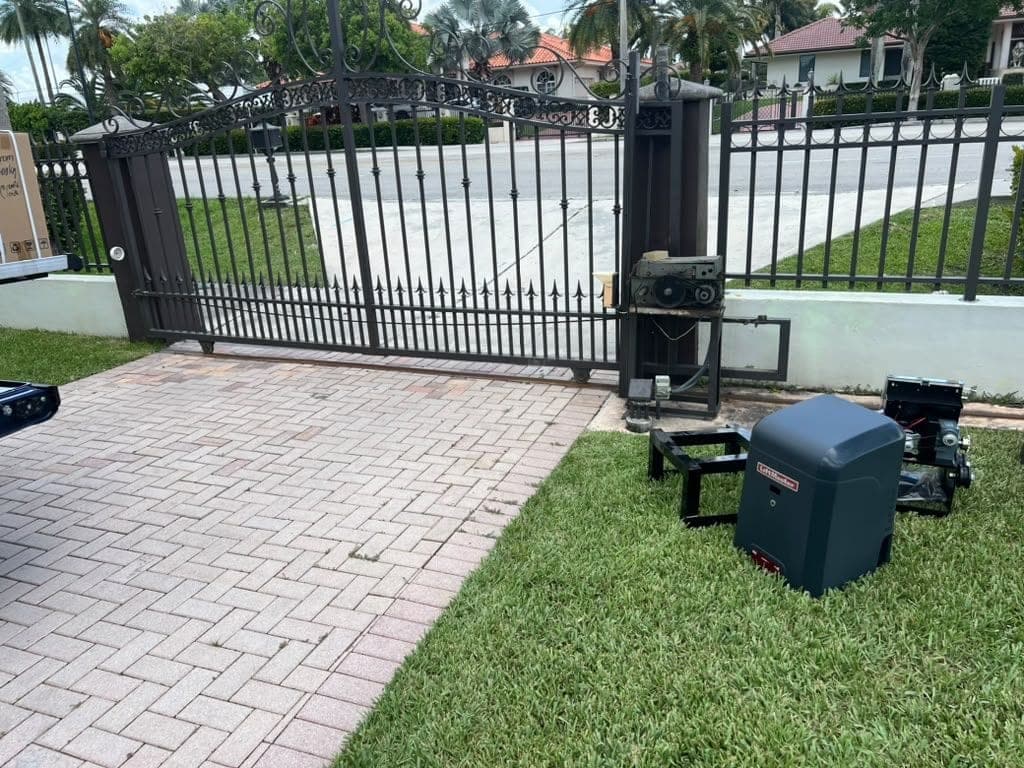
Slide operator installed on its pad beside a black metal fence and driveway

Maintenance · Operators

Almost no gate operator dies without notice. It gets slower, noisier, fussier and less consistent first — and every one of those is a symptom with a specific cause worth catching early.

July 31, 20265 min read1,199 words

The expensive version of a gate failure happens at seven in the morning with a car pointing at a closed gate. The cheap version is the one you noticed three weeks earlier, because the gate had started hesitating on the way open. Same fault, very different day.

Operators are mechanically simple and electrically fussy, which means they degrade rather than snap. Here is what the degradation sounds and looks like, and what each symptom usually turns out to be.

It has got slower

This is the earliest and most reliable warning, and it is the hardest to notice because it happens over months. If you can no longer clear the gate without stopping the way you used to, the cycle time has changed.

  • A DC operator that is slow only in the morning, or only after a cloudy week on solar, is telling you about the battery — not the motor.
  • Slow in both directions, all the time, usually means the gate has become physically harder to move. Drag, not weakness.
  • Slow in one direction only points at something asymmetric: a track that is out of level, a hinge that is dropping, a leaf that has sagged.

Release the manual disconnect and move the gate by hand. That test separates the two categories — a gate that is heavy by hand has a mechanical problem the operator has been compensating for, and a new operator would only be a fresh machine to wear out.

It sounds different

You know what your gate sounds like even if you have never thought about it. Changes in that sound are diagnostic, and roughly in order of urgency:

The sound

  • Humming with no movement, or a lurch then a stall.
  • Grinding or crunching from the gearbox.
  • Rhythmic clicking that speeds up with the gate.
  • A hard bang at the end of travel.
  • Chattering or buzzing from inside the cabinet.
  • Squealing that changes with the weather.

What it usually is

  • Electrical — a failed start capacitor on an AC unit, or a battery collapsing under load on a DC one.
  • Gearbox wear or lost lubricant. This is the one that turns into a replacement fastest.
  • A worn sprocket, a hooked chain link or a flat-spotted roller.
  • Limits drifted, or a slowdown/soft-stop setting lost after a power interruption.
  • Relays or a contactor with pitted contacts — a board-level issue, not a mechanical one.
  • Dry bearings, or grit in the track. Cheap now, expensive if ignored.
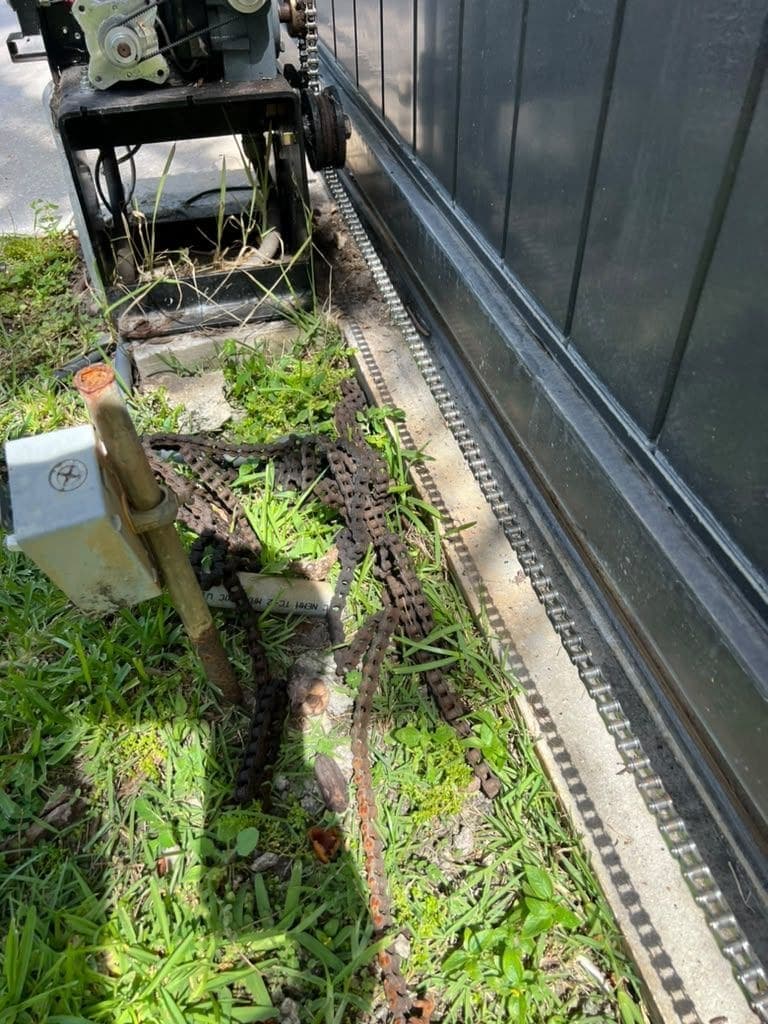
Chain drive and worn hardware exposed alongside an overgrown sliding gate rail
Chain and sprocket wear, exposed

It has become inconsistent

Intermittent faults are the ones people tolerate longest and the ones most worth acting on: "works most of the time" is what a failing connection looks like.

  • Reversing with nothing in its path. Either a safety device is misreporting, or the gate has developed enough drag to trip the force threshold. Both are real faults, not quirks.
  • Needing the remote pressed twice. Weak receiver, a dying transmitter battery, or interference — not "the remote being temperamental".
  • Stopping in a different place each time. Look at power and connections before you look at the mechanics; the pattern for a gate that stops mid-travel tells you a lot.
  • Working in the morning and not in the afternoon, or vice versa. Thermal — something is expanding into a fault, or a solar-charged battery is not keeping up.
  • Behaving differently in the rain. Water is getting somewhere it should not, and that is a corrosion clock that has already started.

What to look at, without opening anything live

Some of this is visible without touching a terminal. The rest belongs to somebody with a meter, because the battery in a DC operator can deliver a serious short and a cabinet that appears dead may not be.

  1. Look at the cabinet from outside. A door that no longer sits flat, a perished gasket, rust weeping from the base — all mean water has been getting in.
  2. Look at the mounting pad. An operator that has shifted, settled or is standing in a puddle after every rain is on borrowed time.
  3. Look at the chain or the drive. Slack that has appeared, a chain riding high on the sprocket, teeth that have gone hooked rather than symmetrical.
  4. Look at the hinges and rollers. Rust bleeding from a hinge, a roller with a flat spot, a wheel that has stopped turning and started sliding.
  5. Look at the gate itself. A leading edge that has dropped relative to the receiver post means the leaf has sagged, and the operator is now fighting geometry.
  6. Look at the ground under the arc or along the track. Fresh scuff marks are the gate telling you where it is touching.
Operator control board wired in its cabinet with the door open on site
Where intermittent faults live

After a storm, check these

Hurricane season is hard on operators for reasons unrelated to wind speed: grid power cycling, nearby lightning, driven rain hitting cabinets from angles they never normally see, and a week on battery.

  • Run a full cycle and listen. Compare it to what you remember from before.
  • Test the photo eyes and edges deliberately rather than assuming they survived.
  • Check the battery has actually recovered — a battery deeply discharged during an outage may never come back to full capacity.
  • Look for water inside the cabinet and at the base of the posts.
  • Check the gate is still hanging true. Debris impacts bend leaves and shift posts without leaving obvious damage.

Repair or replace

There is no universal rule, but there is a useful way to think about it. Boards, batteries, capacitors, limits, chains, sprockets and rollers are wear items — replacing them on a sound machine is straightforward maintenance. A worn gearbox, a corroded housing or a case where the operator was undersized for the gate from day one is different: you are rebuilding a machine that will keep asking for more.

The question worth asking is what the machine is being asked to do. If the gate has got heavier, if the household now runs it forty times a day instead of four, or if a light residential unit was fitted to a solid-clad leaf, then repairing it returns you to a machine that was never right — and the honest answer is a correctly sized operator, not another board.

If your gate is doing any of the things above, it is worth looking at while it is still a symptom. We diagnose and repair operators across Hollywood, Aventura, Delray Beach and everywhere else in the three counties. Describe the noise and the pattern — that is usually enough to know what we are walking into.
Published by Local Gate Repairs on . Written by the business rather than by a named author — this site does not publish a byline it cannot stand behind. General guidance for South Florida properties: every gate, driveway and operator is different, and permitting is administered locally, so treat this as a starting point rather than a specification for your own entrance. What this site does and does not claim is set out in full on standards & sources.

Next step

It starts witha drawing.

On-site consults across South Florida. You see the gate on your own entrance before you commit to anything.

Call NowGet a Quote