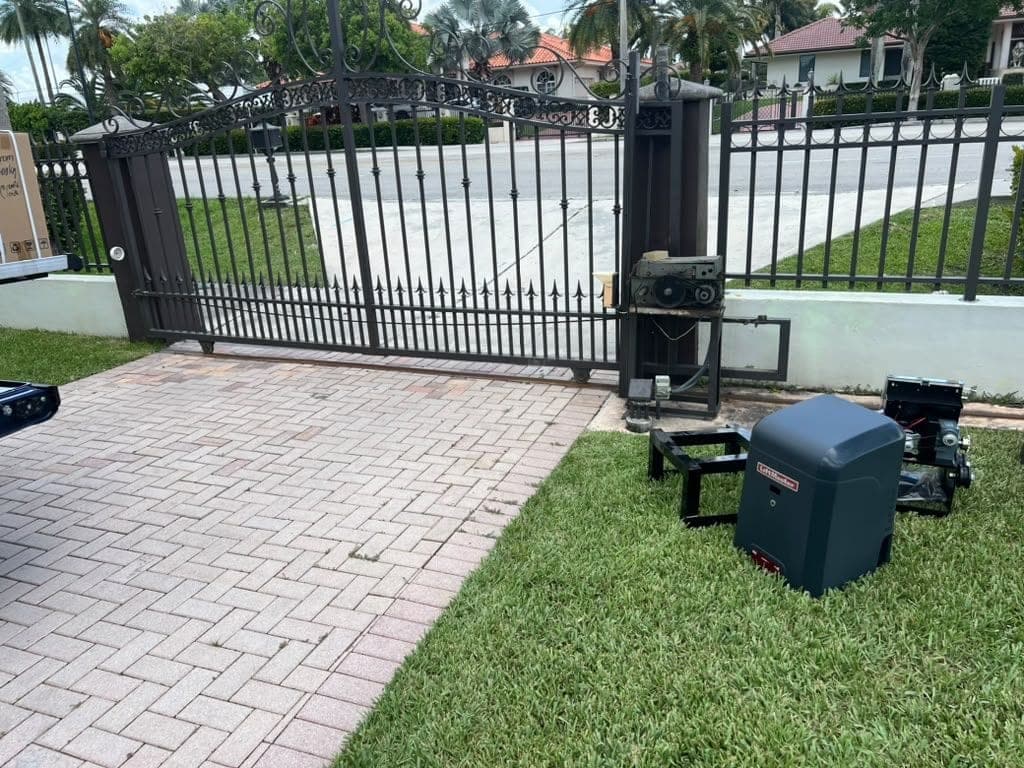
Technician working on an ornate iron gate at a residential entrance

Ownership · Maintenance

Most service intervals in an operator manual were written for a climate with four mild seasons. This part of Florida has two hard ones, and each attacks a gate in a completely different way. Here is the calendar that matches the weather actually outside.

July 31, 20266 min read1,296 words

An automatic gate is the only machine on a residential property that runs several times a day, moves a few hundred pounds of steel through a space people walk in, and lives its whole life outdoors. Nobody services it. It works until it does not, usually at the least convenient hour.

Why the manual's schedule does not fit here

Service intervals in an operator manual are national averages, written for a gate that is cold and dry part of the year and mild the rest. South Florida gives it neither: six months of heat, daily rain, standing water, explosive plant growth and constant lightning, then six months of dust, wind-blown grit and — near the coast — a salt film that never quite washes off.

So the useful schedule is not quarterly-and-annual. It is a short monthly look, a hands-on pass every three months, two seasonal jobs, and one service a year with the cover off.

The monthly walk, which takes five minutes

Stand outside and watch the gate run one full cycle without doing anything else. That single act catches more than any checklist, because what you are testing is your own memory of how it used to sound.

  • Listen. A new grinding, clicking or squealing note is data, not character. So is a gate that has started to hesitate at the same point every time.
  • Watch the line. Does a swing leaf sit lower than it did? Does a slide gate rock as it crosses a particular spot?
  • Wipe the photo eye lenses with a dry cloth. Webs, dust and lawn-clipping film are the commonest cause of a gate that reverses for no reason.
  • Check the manual release is still reachable — not behind a planter, not padlocked, not buried in a hedge.
  • Break the photo eye beam with a broom handle while the gate is closing, and confirm it stops and reverses.

Every three months: hands on the hardware

Swing gates

Work the hinges first. Use a marine-grade grease rather than a general-purpose spray and wipe the excess off — grease standing proud collects grit and becomes a lapping compound. Then look hard at the bracket where the operator arm meets the leaf: that joint takes every start and stop the machine makes, and it is where fatigue cracks appear first.

Then check the stops. A swing gate should land against a physical stop, not against the operator's internal limit — otherwise the machine absorbs the impact of every close, and it was not designed to.

Slide gates

Clear the track with a stiff broom and a shop vacuum, not a hose — water pushes sediment further into roller bearings instead of removing it. Then run the gate slowly by hand with the drive released and feel for a roller that hesitates or a wheel with a flat spot; a wheel that has stopped rotating and started sliding grooves itself within weeks.

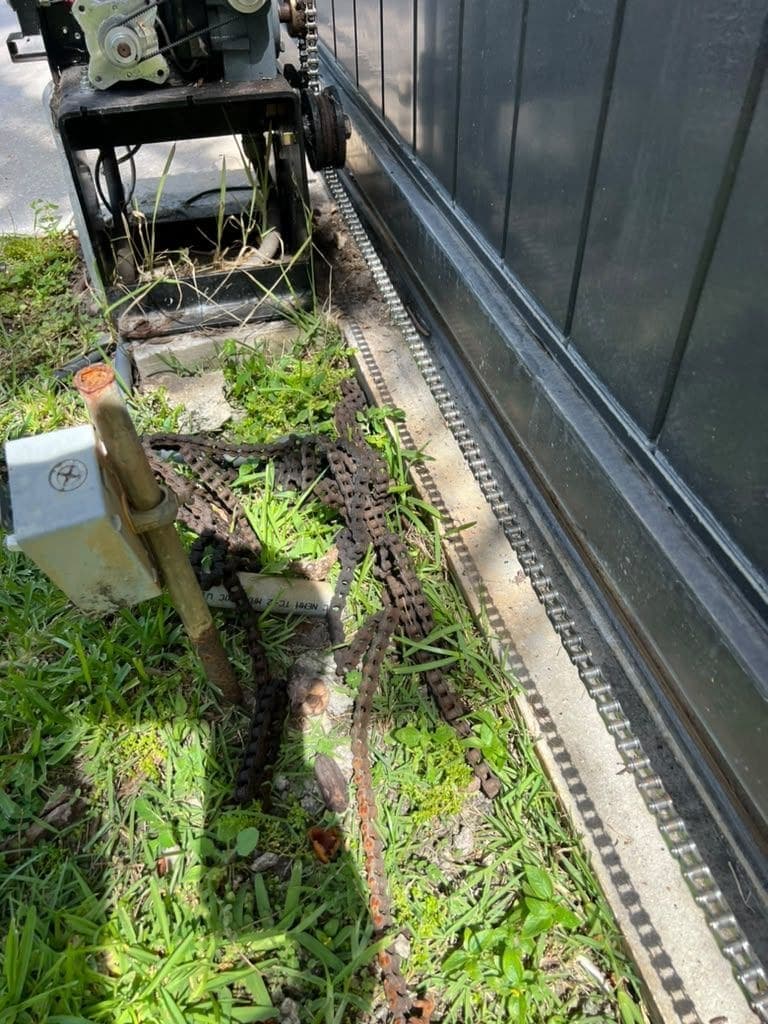
  • Check chain tension. A drive chain wants a little deflection at mid-span; one hanging in a loop jumps a sprocket tooth, and one pulled bar-tight destroys bearings.
Chain drive and worn hardware exposed alongside an overgrown sliding gate rail
A drive left to run itself into the ground

What the wet season adds

From roughly May into October the enemies are water, growth and lightning, and all three arrive on a schedule.

  • Re-aim irrigation. A sprinkler head hitting a gate post, a keypad or a control cabinet is a daily soaking in mineral-laden water, and it does more damage in a year than the rain does.
  • Watch where stormwater runs. If the driveway sheds across the gate line, a ground track silts up every downpour and the gate ploughs through sediment it was never meant to move.
  • Cut back growth on a shorter cycle than you would think. A hedge in the swing arc, or a vine across a track, is an obstruction the operator reads as a jam.
  • Open the control cabinet after a heavy week. Standing water or a stretched door gasket means the enclosure has stopped being one.
  • Lightning is the leading killer of control boards here. If a surge device is fitted, check its indicator — they are consumable, and a spent one protects nothing.

Coastal properties get a sixth item: rinse the frame and hardware with fresh water, because removing the chloride film removes the thing doing the corroding. The reasoning is in the salt air article, and it matters far more in Hallandale Beach or Key Biscayne than inland.

And what the dry months are good for

The dry season is a different exposure, not a rest. Wind-blown sand gets into tracks, gearboxes and keypad housings and, with no daily rain washing surfaces down, simply accumulates — vacuum more often, not less. It is also the only sensible window for coating work: touch-up paint will not bond to damp metal, and in August nothing outdoors is truly dry. Wire-brush and seal the chips and cut edges now, before June turns each one into a rust bloom.

Once a year, with the cover off

One pass a year needs somebody inside the operator, and it is worth timing for spring so the gate enters storm season in known condition.

  1. Inspect the board and every terminal. Green or white powder on a low-voltage terminal is the warning that precedes an intermittent fault, and those are the expensive kind to chase.
  2. Load-test the backup battery and replace on a schedule, not on failure. A battery that has quietly died stays invisible until the power goes out — the exact moment it was bought for.
  3. Re-check force and limit settings against the actual gate. Force drifts, and a machine turned up repeatedly to overcome a drag is a fault masked, not fixed.
  4. Test every safety device to the manufacturer's procedure, including whether monitored devices genuinely fault the operator when disconnected — see the safety devices article.
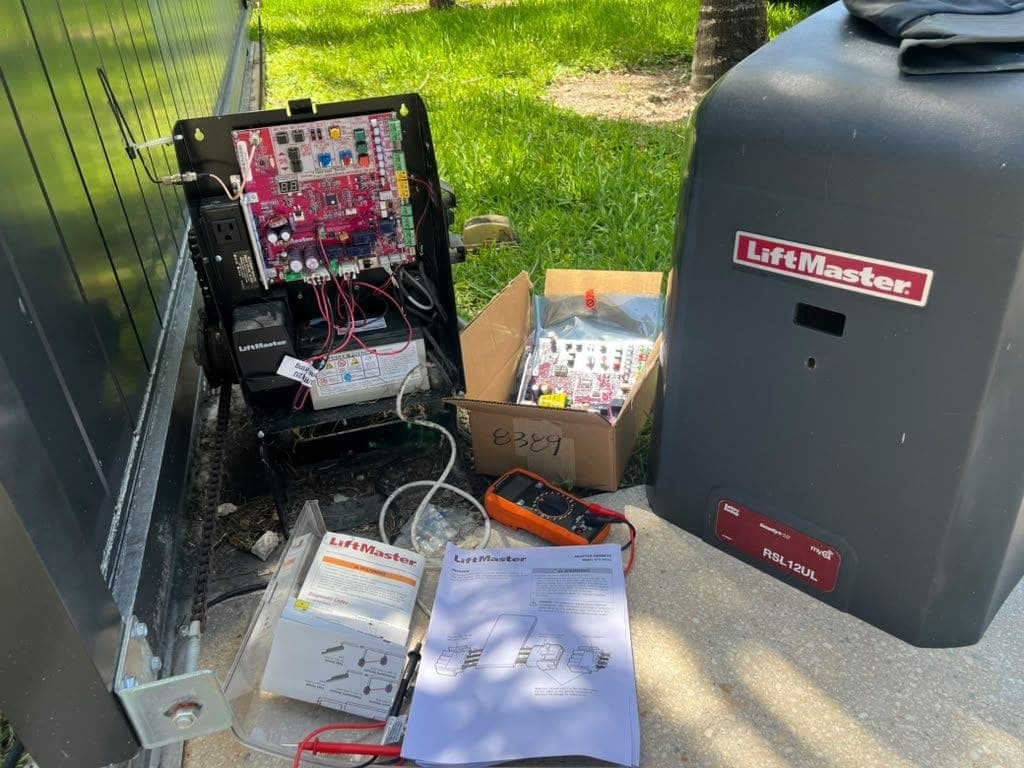
Open gate operator control box with the board out and test gear laid on the ground
The annual pass happens inside the cabinet

The maintenance that does damage

  • Pressure washing. Near an operator, a keypad or a photo eye it drives water past seals designed for rain, not a jet. In a ground track it packs grit into bearings.
  • Using a penetrating spray as a chain lubricant. It flushes out the grease, evaporates, and leaves the chain drier than it started. Grease on a V-track running surface is the same mistake in reverse — it holds sand against steel.
  • Turning up the force setting to make a stiff gate finish its travel. That converts a mechanical problem into a safety problem.
  • Bypassing a photo eye that nuisance-trips. The eye is usually right; the fault is dirt, alignment or a corroded connection — see why a gate stops mid-travel.

None of this is complicated and most of it is free. The gates that reach fifteen and twenty years in this climate are not the expensive ones — they are the ones somebody looked at once a month. If the walk-round turns up something you would rather not touch, that is what gate repair is for, anywhere on the coverage list. Tell us what changed and when it started.

Published by Local Gate Repairs on . Written by the business rather than by a named author — this site does not publish a byline it cannot stand behind. General guidance for South Florida properties: every gate, driveway and operator is different, and permitting is administered locally, so treat this as a starting point rather than a specification for your own entrance. What this site does and does not claim is set out in full on standards & sources.

Next step

It starts witha drawing.

On-site consults across South Florida. You see the gate on your own entrance before you commit to anything.

Call NowGet a Quote