Every automated gate in South Florida will eventually be asked to work without grid power. Whether that is a non-event or a crisis comes down to a battery you have not thought about and a release handle you have never used.
July 31, 20266 min read1,318 words
Outages here come in two kinds. Routine — an afternoon cell drops a feeder for an hour, several times a summer. And not routine at all, when a named storm takes a neighbourhood off the grid for days. The difference between a gate that shrugs and one that traps a car on a driveway is usually decided months in advance.
What actually keeps working, and why
Most residential operators sold in this region are DC machines. The motor runs on a low-voltage battery, and the transformer or solar panel keeps that battery charged rather than running the gate directly. That is why your gate carries on when the house lights are out: the outage removes the charger, not the power source. The gate is always running on the battery.
AC operators are the opposite. The motor runs on line voltage and, unless somebody fitted a battery backup module, the gate stops when the grid does. If you do not know which you have, turn the breaker off and press the remote.
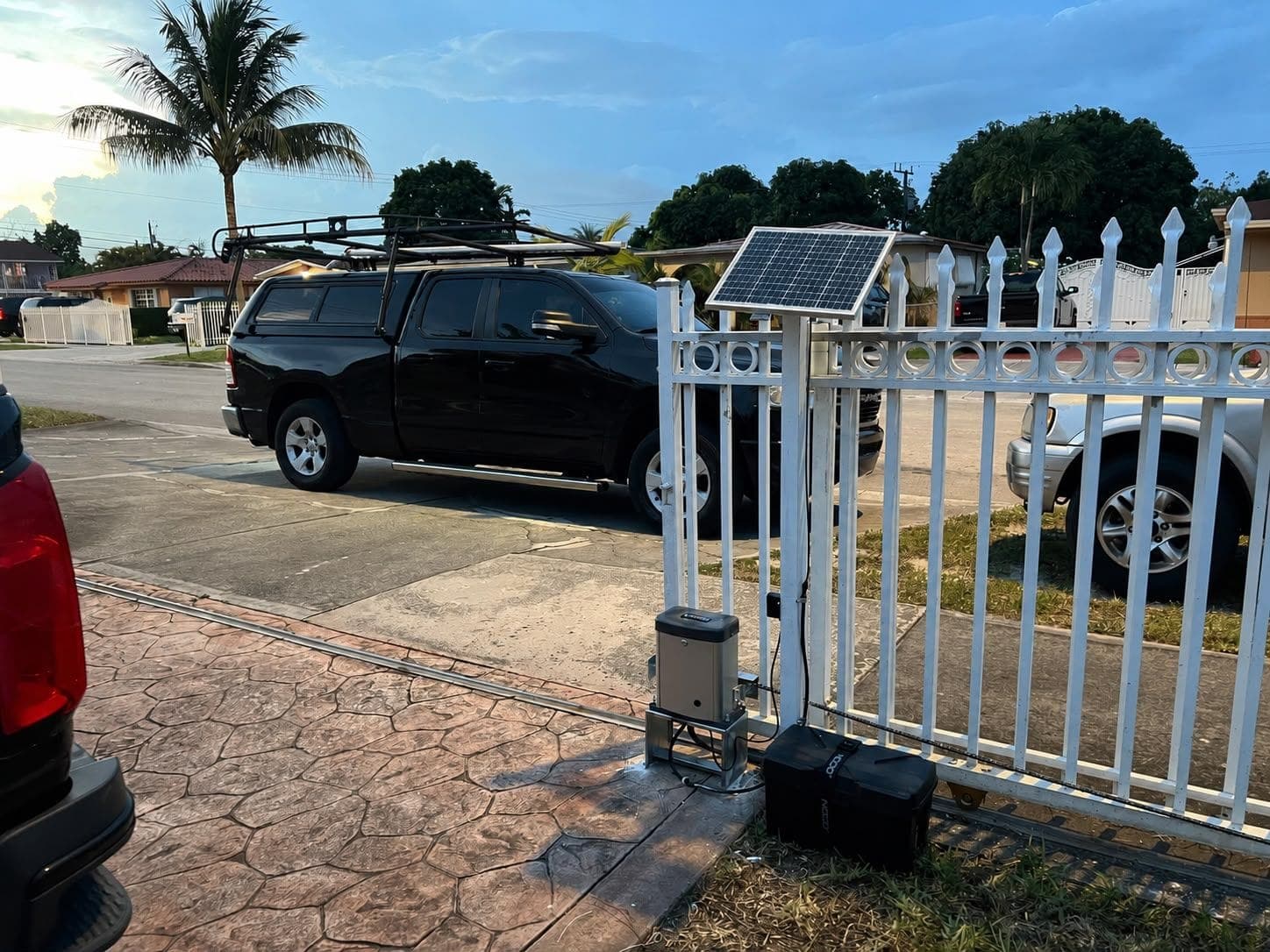
Solar sites are a third case. The panel is sized for a normal duty cycle in normal light, which is why an install that never misses a beat in April can struggle through four grey days of a tropical system. Shade from a grown palm, or a panel filmed with salt and pollen, shrinks the same margin year-round.
A solar site is a battery site with a slow charger
The battery is the whole story
How many cycles you get on backup is not a number anyone can quote honestly — it depends on the weight of the gate, the health of the mechanics and above all the age of the battery. What is worth knowing is how these batteries fail, because it is not gradual in the way people expect.
Sealed lead-acid batteries — the AGM bricks in almost every operator cabinet — are killed by heat far more than by use, and a cabinet in full August sun is a hostile place to live. The failure mode is internal resistance: capacity goes first, then the ability to deliver current under load. That gives you a battery reading healthy voltage at rest which collapses the moment the motor asks for starting current, which is why a gate that hums and does not move is so often a battery rather than a motor.
A battery deeply discharged during a long outage often never returns to its previous capacity. The outage does not just drain it, it shrinks it.
Resting voltage tells you very little. A load test is the only meaningful measurement.
A gate that has been slower first thing in the morning is the battery reporting itself early.
A cabinet taking water adds a second problem — corroded terminals put resistance in exactly the wrong place.
The manual release: find it before you need it
Every automatic gate operator sold in the US must provide a way to disengage the drive and move the gate by hand, because the safety standard the industry works to requires it. That release is what stands between you and a blocked driveway, and a surprising number of homeowners have never found theirs.
Where it is depends on the machine. On a swing arm or ram, typically a small keyed cover on the body. On a chain-drive slider, a lever or knob on the gearbox. On rack-and-pinion, sometimes a hinged plate that lifts the pinion clear. Some need a key kept inside the cabinet — no use if the cabinet is behind the gate.
01Find the release now, in daylight, with power on. Operate it once so you know the force it takes and which way it goes.
02Find the key it needs and put a copy somewhere that is not behind the gate.
03Before disengaging, make sure the gate cannot be commanded — a battery-backed operator may still be live.
04Move the gate slowly, pushing on the frame rather than on scrollwork or a single picket.
05Secure it once open. A free-swinging leaf in gusting wind is several hundred pounds with nothing controlling it, and it will find a car.
06Re-engage and run one full cycle under power when the outage ends, so the operator can re-establish open and closed.
The gate is only half of it
The gate can be running happily on its battery and you can still be locked out, because whatever sends the open command has its own power story.
A keypad or receiver powered from the operator's own low-voltage supply stays up as long as the gate does. That makes a plain keypad the best redundant entry method there is.
A device on its own transformer plugged into a house circuit dies with the house.
Telephone entry over a VoIP or cable line goes down when the internet does, which in a storm is immediately. A cellular callbox with its own battery does not.
Cloud-managed app entry needs site internet and panel power. Assume it is unavailable and keep a physical method.
The gate that fails when the power comes back
A meaningful share of post-storm gate calls are not about the outage at all — they are about restoration. Power returning after a fault brings switching transients, and lightning near a property induces surges onto every long conductor on site: buried loop leads, photo eye runs, the antenna, the intercom cable. Those act as antennas for a nearby strike whether or not anything was hit directly.
The result is a board or transformer that was fine all week on battery and dead ten minutes after the lights came back. Sometimes it is subtler: a receiver whose memory was wiped, so every remote stops at once, or a loop detector that has faulted and now holds the gate open indefinitely.
The pre-storm walk-round
None of this needs tools. It needs fifteen minutes at the start of the season, before anything is named on the map.
Kill the breaker feeding the operator and cycle the gate several times. It is the only backup test that means anything.
Operate the manual release once, and confirm the key exists and is reachable from outside the gate.
Note the age of the battery. If nobody remembers replacing it and it has seen two summers, plan on it.
Clear the track, arc and hinge line, and check the cabinet door still seals.
Check the solar panel is clean and unshaded at midday, not just at the hour you happen to look.
Decide in advance whether you want the gate open or closed if you evacuate, and make sure whoever stays knows how to move it.
Published by Local Gate Repairs on . Written by the business rather than by a named author — this site does not publish a byline it cannot stand behind. General guidance for South Florida properties: every gate, driveway and operator is different, and permitting is administered locally, so treat this as a starting point rather than a specification for your own entrance. What this site does and does not claim is set out in full on standards & sources.