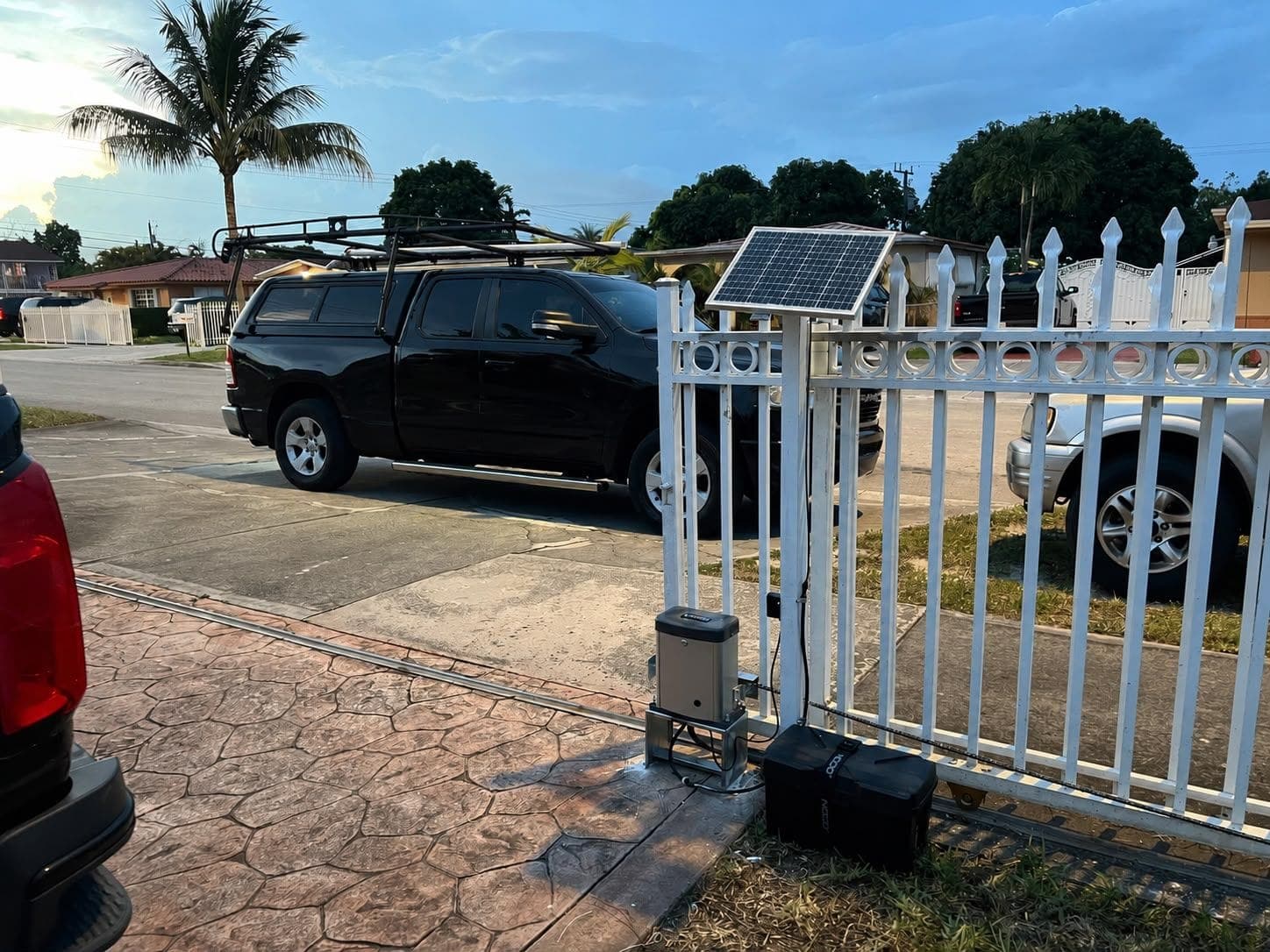
Solar panel mounted above a white aluminum gate powering its operator

Power · Operators

Solar is not a lesser version of mains power — it is the same job with a fixed energy allowance. Whether it works comes down to arithmetic you can do before anyone quotes you.

July 31, 20266 min read1,300 words

Solar gate power has a reputation problem in both directions. Half the people who ask about it expect to be left stranded, and half expect free electricity that removes a trench from the quote. Neither is right. A solar operator is a battery-powered operator with a slow charger bolted to it, and the only question that matters is whether the charger keeps up with what the household actually does.

The good news is that this is arithmetic, not opinion, and you can do the first half of it yourself.

Start by counting cycles, honestly

A cycle is one open and one close. Count a normal weekday and be brutal about it: every departure and return, the housekeeper, the landscaper, two deliveries, the pool service, the kids, the food drop-off at nine at night. Households routinely guess six and land on twenty-five once they count. Then think about the worst realistic day — a party, a move, contractors in and out all afternoon — because that is the day the system either copes or does not.

  • A quiet single-vehicle household with a light swing gate is comfortably inside what a modest panel supports.
  • A busy family plus regular services is the middle case, and it is where sizing has to be deliberate rather than default.
  • A shared entrance, a short-let property or anything commercial is a different category entirely — see commercial gate systems rather than treating it as a big house.

What the panel actually has to cover

A solar system has three parts and people only ever look at one of them. The panel collects, the battery stores, and the controller decides how the two talk. The panel is sized against the average day; the battery is sized against the bad stretch. Getting the second one wrong is what produces a gate that has worked all spring and then dies on the fourth grey day in August.

The things that quietly shrink the panel's output are all local and all boring:

  • Shade. A panel that is half shadowed for two hours a day is not producing half — partial shading hurts output disproportionately. Palms move, and hedges grow into the arc over a couple of seasons.
  • Orientation. Flat-mounted panels collect less and, worse, do not shed dirt. A tilted panel facing roughly south is worth more than a bigger flat one.
  • Soiling. Dust, pollen, salt film and irrigation overspray all cut transmission. This is the maintenance item nobody is told about.
  • The wet season. A run of heavily overcast days in the summer is normal here, and that stretch — not the annual average — is what the battery has to bridge.
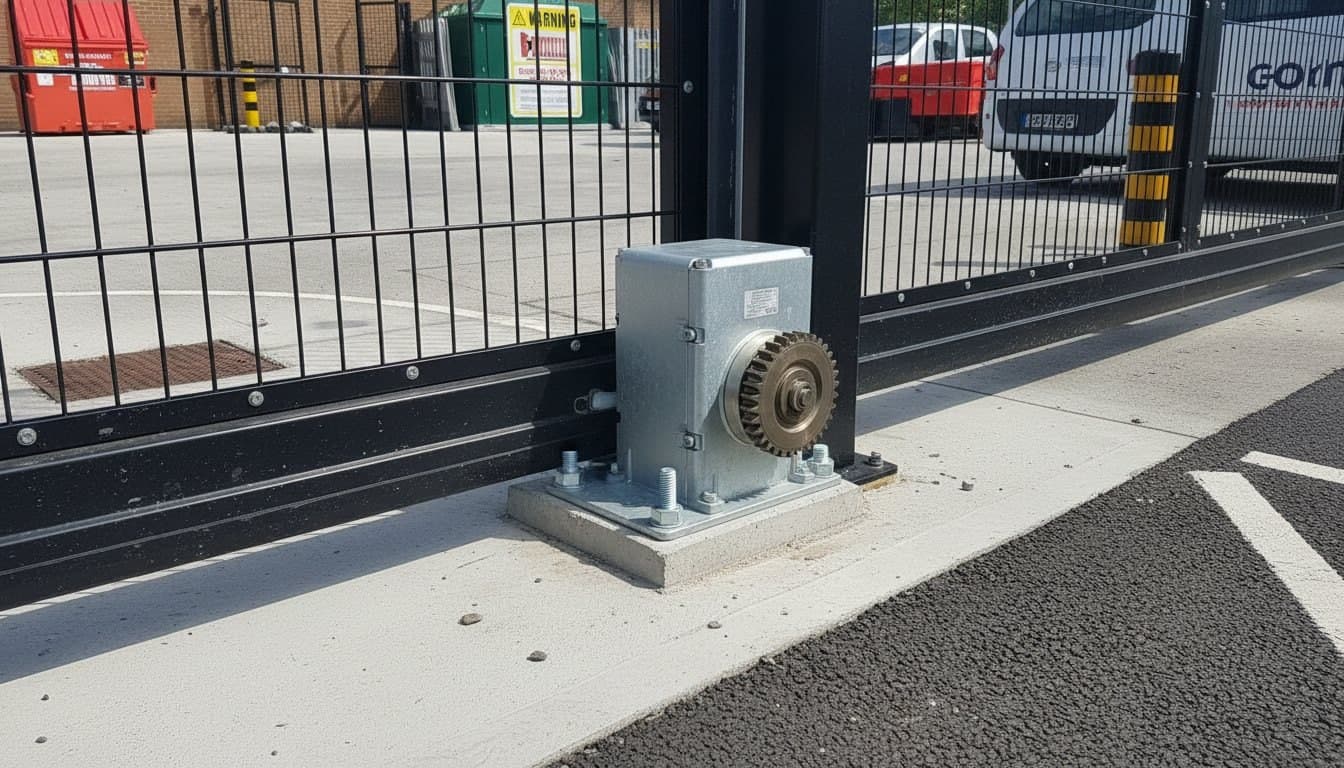
Rack-and-pinion slide gate operator bolted to a concrete pad at the gate post
A big slide gate asks for more energy per cycle than a light swing leaf

The gate is half of the equation

Energy per cycle is not a property of the operator alone. It is what the operator has to overcome, which is mass, friction and wind. A heavy solid-infill slide gate on grit-filled rollers draws far more per cycle than a light open-picket swing leaf on clean hinges, and the difference compounds across thousands of cycles a year.

That means the cheapest way to make solar work is often not a bigger panel. It is a lighter gate, a cleaner track and hinges that are actually serviced. A gate that is dragging is also a gate that is wearing its operator out early, so the same maintenance pays twice.

What mains power buys you

A hard-wired operator removes the energy question completely. It also removes the failure mode where a gate works perfectly for two years and then becomes unreliable because a battery has quietly aged out. Beyond the motor itself, mains power supports the things people add later without thinking: a video callbox, a long-range reader, gate lighting, a camera, a heavier operator when the gate is replaced. Those are the additions that turn a marginal solar system into an unreliable one.

The cost of wired power is almost never the operator — it is the ground between the panel and the gate. Distance drives conductor size because of voltage drop, the route decides whether you are trenching through lawn or cutting a paver driveway and making it look untouched afterwards, and the restoration is often the largest part. This is one of the biggest single variables in a gate quote, and it is covered in more detail in what drives the cost of a driveway gate.

Side by side

Solar

  • No trench, no restoration, no permanent circuit at the gate.
  • Runs through a power cut for as long as the battery lasts.
  • Capped by the energy budget — heavy use or a heavy gate needs real sizing.
  • Adds maintenance items: battery life, panel cleaning, shade that grows.
  • Awkward to expand later when accessories get added.

Hard-wired

  • Unlimited duty cycle, and headroom for a heavier gate later.
  • Supports cameras, lighting, video entry and long-range readers without argument.
  • Trenching and reinstatement can be the largest line on the quote.
  • Needs its own battery backup to survive an outage.
  • Fewer moving parts in the power path, so fewer things to age out.

Storms, outages and getting out of the driveway

This is where the comparison flips in an interesting way. During a multi-day outage a well-sized solar gate keeps working, because its supply never went away — provided the sky is not still black. A wired gate without battery backup is a manual gate until the power returns, which is exactly the wrong week for it. Backup batteries are the answer either way, and they are the component that ages silently: a backup that has never been tested is not a backup.

Whichever route you take, know how to release the gate by hand, and make sure everyone in the house does too. In storm season that is not an accessory, and it sits alongside the rest of the hurricane-zone thinking a gate here deserves.

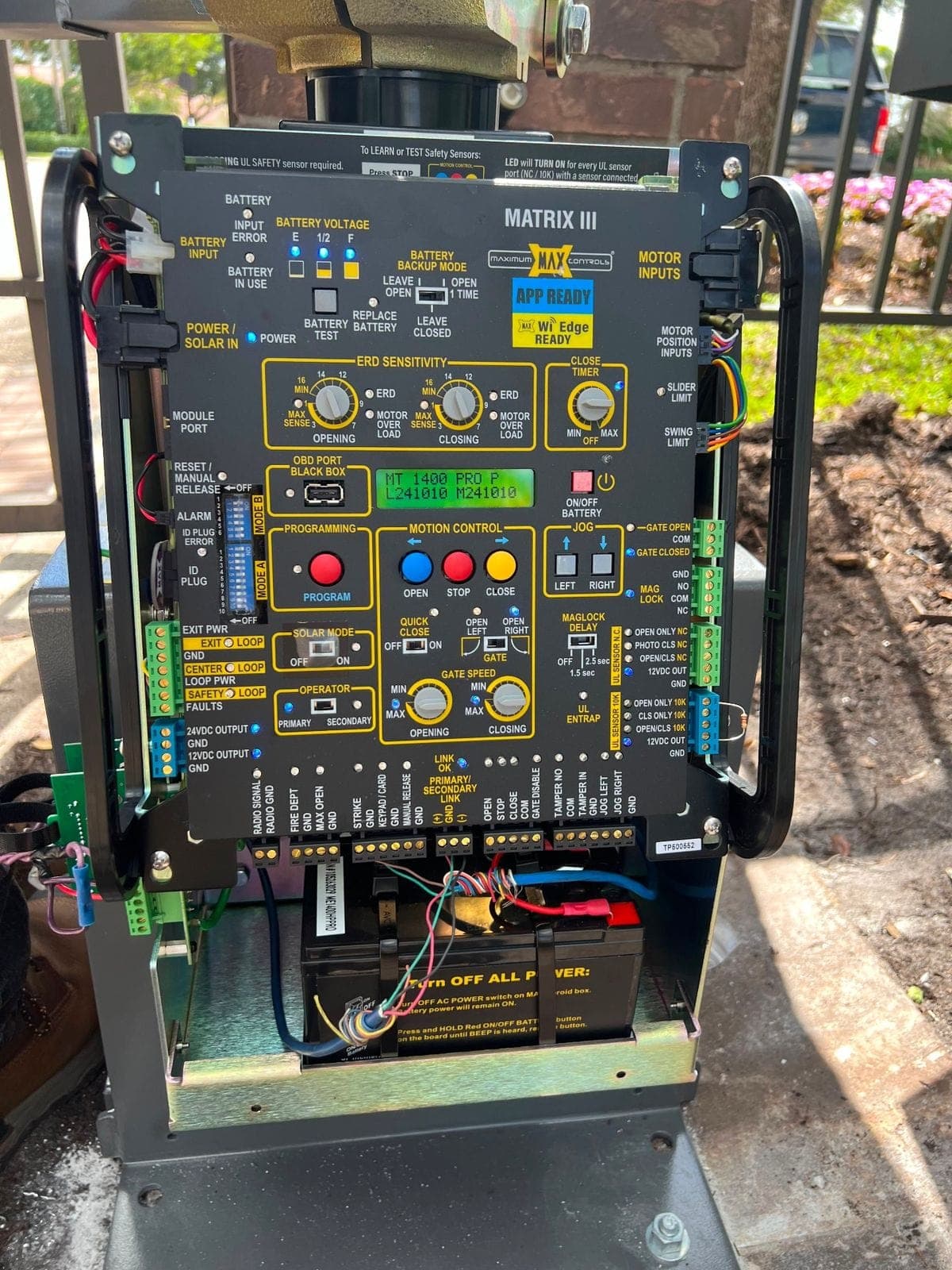
Operator control board wired in its cabinet with the door open on site
Battery, charger and board all live in the same damp box

The short version

  • Light gate, modest traffic, long or expensive trench: solar, sized against your real cycle count and the worst week — not a catalogue figure.
  • Heavy gate, busy entrance, or any intention of adding video entry, lighting or cameras: wire it, and add a battery backup.
  • Long run to the panel across a finished driveway: get the trenching priced properly before ruling solar out.
  • Anything shared or commercial: wired, every time.

If you already have a solar gate that has started to behave differently in the afternoons, or that only fails on cloudy days, that is a diagnosable fault and not the end of the system — usually a battery at the end of its life, a shaded or filthy panel, or a gate that has grown heavy to move. We size, supply and repair operators across Coral Springs, Palm Beach Gardens and the rest of the coverage area. Tell us your daily cycle count and the distance to the nearest panel, and the answer usually falls out of those two numbers.

Published by Local Gate Repairs on . Written by the business rather than by a named author — this site does not publish a byline it cannot stand behind. General guidance for South Florida properties: every gate, driveway and operator is different, and permitting is administered locally, so treat this as a starting point rather than a specification for your own entrance. What this site does and does not claim is set out in full on standards & sources.

Next step

It starts witha drawing.

On-site consults across South Florida. You see the gate on your own entrance before you commit to anything.

Call NowGet a Quote