Almost everything written about storm-proofing a gate is about the gate. The part that decides whether you can get your car out on the morning after is the manual release, the power supply and a rehearsal you have never done.
July 31, 2026Updated August 1, 20266 min read1,332 words
The gate itself is usually the least of your problems in a storm. A correctly built driveway gate is an engineered assembly with a wind pressure it was designed to take, and if it was specified properly for this region that part of the question was answered before it was installed — which is a different subject, covered in what the High-Velocity Hurricane Zone means for a gate.
What goes wrong is more mundane. The power fails, the battery that was meant to cover it has been dead for two years, nobody has ever operated the manual release, and a family sits behind their own gate with a car they cannot move. Every item below exists to prevent some version of that.
Before the season, not during it
The work that matters is done in spring, calmly, with a hardware store still open. Once a system has a name and a cone, everything below gets harder and some of it becomes impossible. Nothing on this page is a forecast, and no gate company should be your source for one — watches, warnings and the cone for your own address come from the National Hurricane Center (NOAA · National Weather Service, opens in a new tab).
01Load-test or replace the backup battery. Sealed lead-acid batteries in a hot outdoor cabinet fail without any outward sign, and one that holds a resting voltage can still collapse under the first motor start.
02Check every ground and bond, and the surge protection device if one is fitted. Lightning is a bigger practical threat to a gate here than wind is.
03Fix mechanical drag now. A gate already labouring will fail the first time it runs on battery, because battery operation is where the margin is thinnest.
04Test the manual release with the power physically off, and make everyone in the house do it once.
The manual release is the entire plan
Every gate operator has a way of disengaging the drive so the gate can be moved by hand — a lever behind a small door, a key-operated cam, a pull cord, or a bolt that has to be backed off. Some need a specific key that lives in a drawer somewhere. The number of households who have never touched theirs is close to all of them.
This is the single highest-value thing on this page: find yours, use it, close it again, and show the other adults in the house. Do it in daylight, on a dry afternoon, with the breaker off — not in the dark, in the rain, with a phone at four percent.
Two things about released gates surprise people. A disengaged slide gate on a slope will roll on its own, sometimes fast — know which way yours wants to go before you release it. And a gate moved by hand has no safety devices working at all, because the operator is no longer in control of anything.
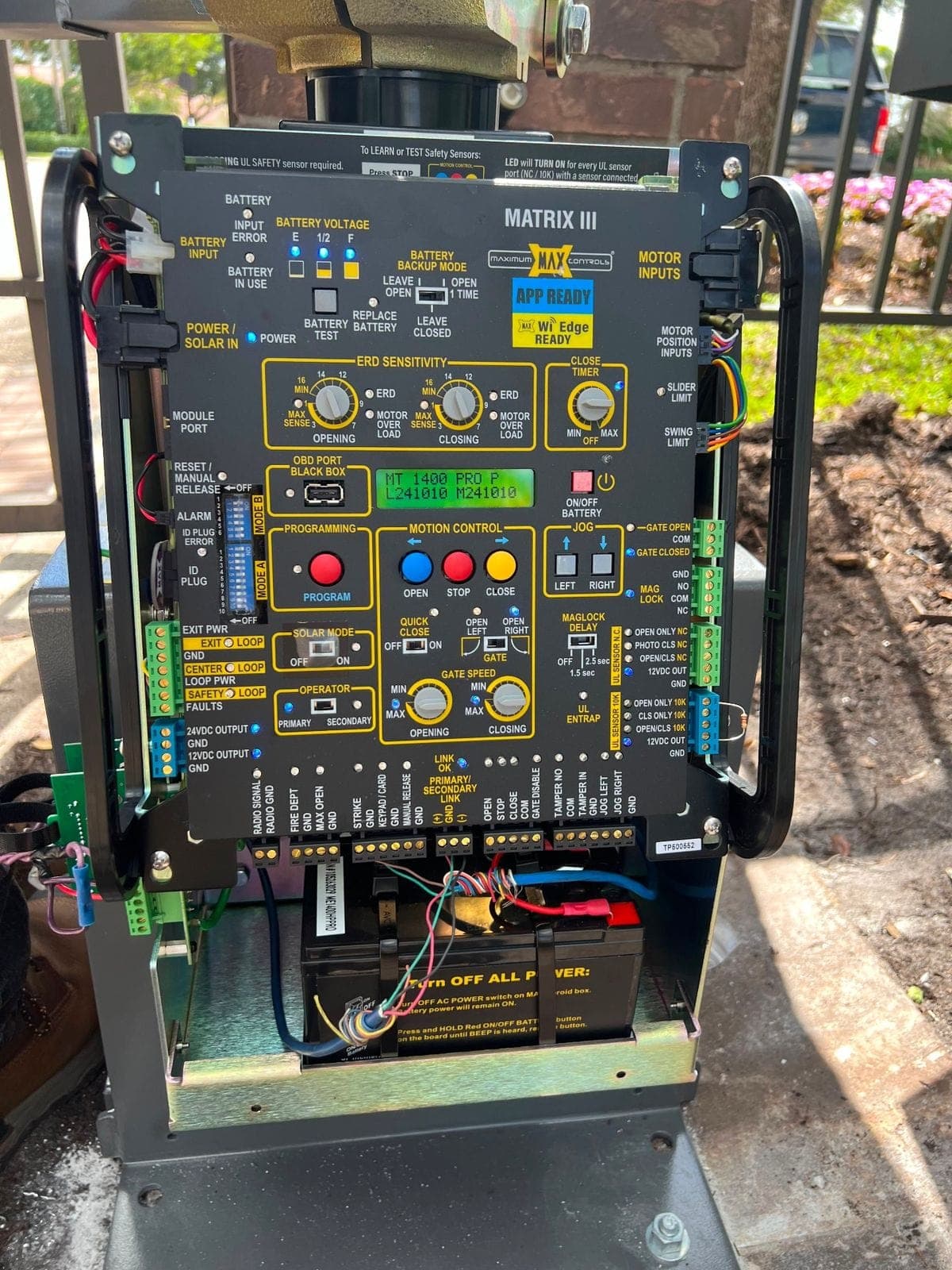
Battery, charger and board — the three things that decide the outage
Battery backup, and the honest arithmetic
Battery backup is real and worth having, but it is sized for an interruption, not for an aftermath. A healthy battery typically carries a residential gate through a run of cycles measured in dozens — enough for an evening, not for four days.
Know what your operator does when the battery runs down. Fails open, fails closed and fails where it stands are all real behaviours, and many machines let you choose.
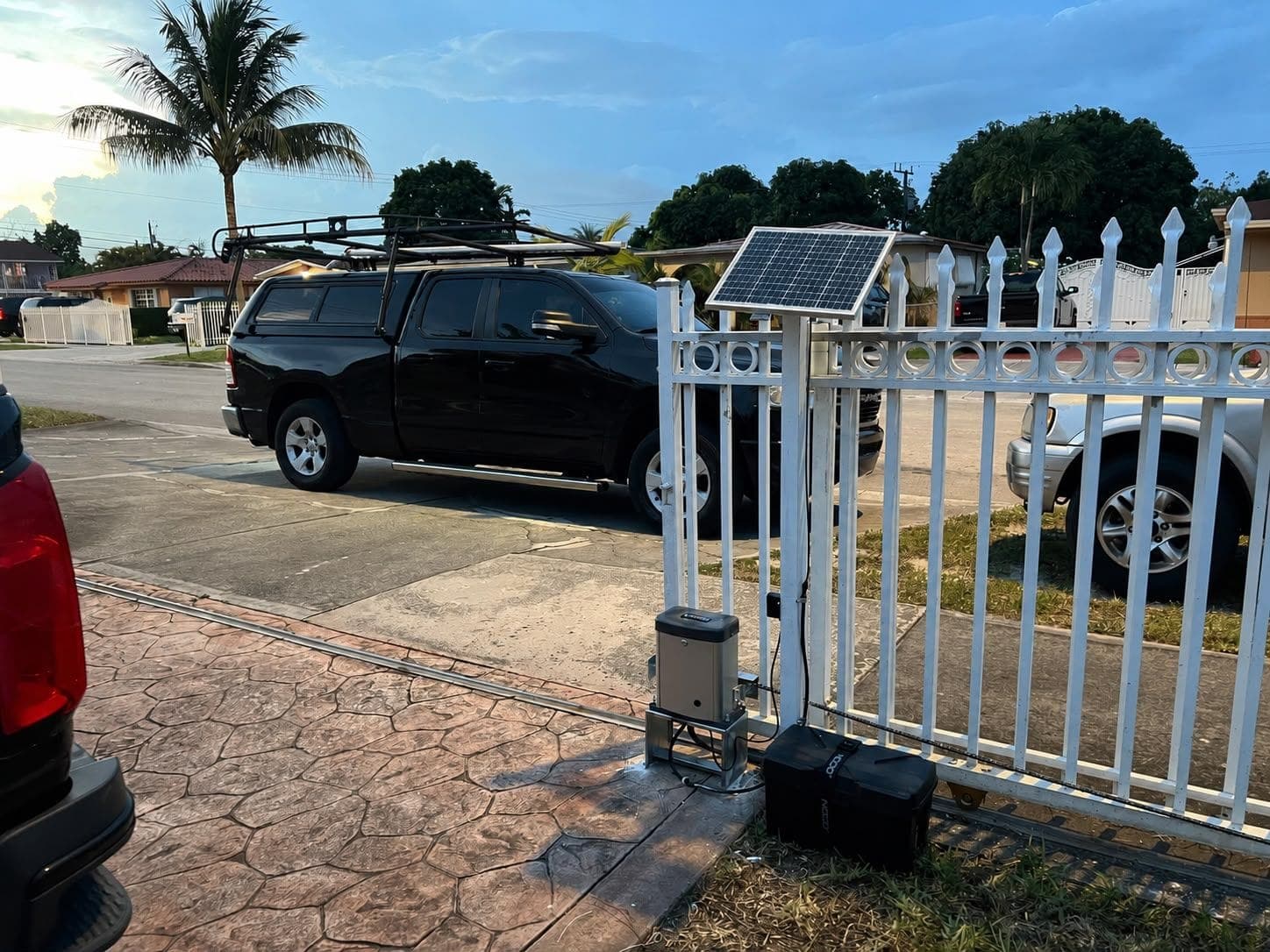
Solar-assisted gates are not automatically better. Days of heavy overcast after a system passes are when a panel produces least.
The practical decision to make in advance is simple: if the power is out for days, do you want the gate parked open or parked closed? Open means access for you, a neighbour and emergency vehicles. Closed means security while a property sits empty. There is no universally right answer, but there is a right one for your household, and deciding it in June beats deciding it at 3am.
When there is a cone on the map
In the last day or two before conditions deteriorate, the useful actions are small and quick.
Clear the swing arc or the slide run of anything that could become an obstruction — bins, planters, furniture, loose landscaping stone.
Clean out a ground track properly. It will fill with debris and water during the storm, and a gate that cannot complete its travel afterwards trips its force limit and stops.
Charge whatever remote credentials are involved, and write the keypad code and the manual release location on paper. Phones die and networks go down.
Decide the open-or-closed question and set the gate that way before the wind arrives, rather than changing your mind during it.
What is theatre
Strapping or tying a gate shut. If a leaf is going to fail, a ratchet strap does not change that — it just stops the gate being opened when somebody needs through, and it can bend a frame by loading it in a direction it was never designed for.
Taping panels or cladding. Tape has never resisted wind pressure. It only changes how the debris breaks.
Removing infill slats "to let the wind through". A gate is engineered as a whole assembly; dismantling part of it does not produce a lighter, safer version, it produces an unengineered one.
Disconnecting the operator battery to "protect" it. That removes exactly the capability you paid for.
Bringing the gate back afterwards
The temptation once the power returns is to press the button and see what happens. Resist it for five minutes.
01Look before you power up. If the operator, the cabinet or any junction box has been submerged or holds standing water, leave the breaker off and get it opened first. Energising a wet board destroys it and can take what is downstream with it.
02Clear the track and the swing path completely — branches, roof material, sand, sediment. Then move the gate by hand through its full travel with the drive still released, feeling for anything that binds.
03Check the posts and the footing. A post that has shifted or a slab that has cracked changes the whole geometry, and a gate running out of alignment eats its own hardware.
04Rinse everything with fresh water. Storm surge and wind-driven salt reach places that never normally see it.
05Re-engage the drive, run one slow cycle while watching, then test the safety devices before you trust the gate again. Water gets into photo eye housings and edge sensors, and a device that failed silently is worse than one that failed loudly.
Storm preparation comes down to three questions: can you open the gate without power, will the battery genuinely do what you think it will, and is the mechanical side healthy enough to run on reduced power. Answer those in the spring and the storm is a weather event rather than an access crisis. If the answers are uncomfortable, the operator side is where to start, in Fort Lauderdale, Coral Gables or anywhere across Miami-Dade, Broward and Palm Beach. Get in touch before the season, not during it.
Sources
The bodies that publish the standards and rules named above. Every link goes to the organisation itself, so anything asserted here can be checked at the source rather than taken on our word.
Published by Local Gate Repairs on , last revised . Written by the business rather than by a named author — this site does not publish a byline it cannot stand behind. General guidance for South Florida properties: every gate, driveway and operator is different, and permitting is administered locally, so treat this as a starting point rather than a specification for your own entrance. What this site does and does not claim is set out in full on standards & sources.